In the knowledge of scholars of Quran recitation, is referring to recitation after cutting off recitation or stopping.
The beginning is only by choice, in contrast to the stop, which may be by choice or compulsion. For that reason it is demanded of the reader when beginning, that he start his recitation with an independent phrase that conveys the intended meaning, not attached to that which precedes it grammatically.
There are two types of Ibtidaa ابتداء :
1-Ibtidaa Haqiqi :when the recitation is initiated a-new أبتداء حقيقي
2- Ibtidaa Taqdeeri : to continue the recitation after a pause. Similarly, completing one Surat and starting the next too will be أبتداء تقديرى او أضافى
We are Quran academy , have Qualified teachers, Book free trial class now, Here.
Therefore Alibtidaa الابتداء divide as Alwaqf الوقف
1-The allowed Ibtidaa (الابتداء الجائز)
2- The Ibtidaa that is not allowed (الابتداء الغير جائز)
1-The allowed Ibtidaa (الابتداء الجائز)
1-Complete Ibtidaa ( الابتداء التام)
a-Any start of a surah
B- the start after a complete stop Examples : start with ayah no. 6 in Surat Al-Baqarah إِنَّ الَّذِينَ كَفَرُوا سَوَاءٌ not attached to the previous ayah.
2-Sufficient Ibtidaa ( الابتداء الكافى)
Example :start with ayah no.7 in ٍSurat Al-Baqarah خَتَمَ اللَّهُ عَلَىٰ قُلُوبِهِمْ وَعَلَىٰ سَمْعِهِمْ Attached to the previous ayah in meaning.
3-Good Ibtidaa ( الابتداء الحسن)
Example:
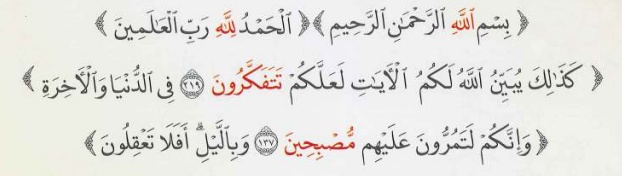
And indeed, you pass by them in the morning – The two ayat attached grammatically and in meaning.
2- The Ibtidaa that is not allowed (الابتداء الغير جائز)
The undesired, detested Ibtidaa (أبتداء قبيح)
repulsive beginning would be when starting with a word that leads to a meaning other than that Allah, The Exalted, wants, or a meaning that is in disagreement with our creed.
More Examples:
– Start with اتَّخَذَ الرَّحْمَنُ وَلَدًا(88)
“Allah has taken a son.” (Astaghfirullah) Without saying first “They say” وَقَالُوا
In surat Al-Ma‟idah aya 64
Start with يَدُ اللَّهِ مَغْلُولَةٌ The hand of Allah is chained.
Without saying وَقَالَتِ الْيَهُودُ And the Jews say
The optional stop is divided into four categories:
1-The inclusive, complete waqf (وقف تام)
2-The sufficient, permissible waqf (وقف كافى)
3-The reliable, accepted waqf (وقف حسن)
4-The undesired, detested waqf (وقف قبيح)
3-The reliable, accepted waqf (وقف حسن)
The accepted, permissible waqf is that which is made on such a place where there is a connection between the sentences, before and after, both in word and meaning. However there is no corruption in the meaning.
Just as the other stops. It is called “hasan” or good due to the fact that stopping on it leads to understanding of a meaning.
⇒ The rule for the good stop: it is allowed to stop on it, but not allowed to start on what follows it due to its attachment to what follows grammatically and in meaning, except on the end of an Ayah. Stopping on the end of an Ayah is Sunnah.⇐
Examples;
Examples;
-You can stop on the word هللا as the meaning in itself is fully understood
In the name of Allah – بِسْمِ اللَّـهِ
The Entirely Merciful, the Especially Merciful. – الرَّحْمَـٰنِ الرَّحِيمِ
-But you cant start with what comes next due to its attachment to what follows grammatically and in meaning .
We are Quran academy , have Qualified teachers, Book free trial class now, Here.
4-The undesired, detested waqf (وقف قبيح)
It is the stop on what does not give a correct meaning, and that is due to its strong attachment to what follows in grammar, and in meaning.
⇒ The rule for the repulsive stop: This stop not allowed intentionally. It is only allowed when compelled in such as a situation as unexpected shortness of breath, sneezing, or forgetting ⇐
After the state that compelled the stop has past, the reader then must repeat one, two, or more words, as necessary to convey the correct and sound meaning.
Do not stop on a verb without its subject (the doer of the verb).
Do not stop on a subject of a verb without the object of the verb.
Do not stop on a preposition without the object of the preposition.
Do not stop on a possessive noun ( possessed ) without the possession expression ( the possessor ) / two nouns the second is the possessive of the first noun.
Do not stop on the subject of the nominal sentence without the predicate – a nominal sentence in Arabic has no verb.
Do not stop on a word with is characterized without that which characterizes it.
Do not stop on a conjunction without its conjoined noun.
Do not stop on a noun which is in a state ( or case) without the word which gives the state (accusative).
So not stop on a number ( count) without that which is being counted.
And don’t stop on an emphasized noun without the emphatic term.
The stop signs on words in the Madinah printing of the Quran.
Very important note:
-There is no Waqf(stoppage) in the Quran that is obligatory or Forbidden Islamically except that which distorts the meaning .
The optional stop is divided into four categories:
1-The inclusive, complete waqf (وقف تام)
2-The sufficient, permissible waqf (وقف كافى)
3-The reliable, accepted waqf (وقف حسن)
4-The undesired, detested waqf (وقف قبيح)
1-The inclusive, complete waqf (وقف تام)
There is no connection either in word or meaning between the sentence before with the one appearing after it.
or It is the stop on a Qur’anic word complete in meaning and not attached to what follows it in grammatical expression or in meaning.
This waqf is generally made at the end of an Ayat, narratives, and incidences.
⇒ The rule for the complete stop: It is best to stop on the word that is a completestop, and then start on what follows it ⇐
Examples;
To make waqf on (5 وَأُوْلَئِكَ هُمُ الْمُفْلِحُونَ [سورة البقرة in Surah Baqarah, Those are upon [right] guidance from their Lord, and it is those who are the successful
Then start
إِنَّ الَّذِينَ كَفَرُوا سَوَاءٌ عَلَيْهِمْ أَأَنذَرْتَهُمْ أَمْ لَمْ تُنذِرْهُمْ لَا يُؤْمِنُونَ (6) – Indeed, those who disbelieve – it is all the same for them whether you warn them or do not warn them – they will not believe.
We are Quran academy , have Qualified teachers, Book free trial class now, Here.
The compulsory (required) stop
Known in the Mushaf by the small Meem sign مـ ,shows that there is a must to stop , not stopping on this word could change the intended meaning of Allahs words.
Meaning:
Only those can accept who hear. As for the dead, Allah will raise them up; then unto Him they will be returned .
The sufficient waqf is that waqf in which there is connection between the previous ayat with the one appearing after it in meaning only and not in word – but not in grammar .
This waqf generally takes place on ayat’s and symbols of waqf.
⇒ Its rule: It is advisable to stop on it and start with that which follows, just as in the complete stop ⇐
Examples:
stop on – (6) إِنَّ الَّذِينَ كَفَرُوا سَوَاءٌ عَلَيْهِمْ أَأَنْذَرْتَهُمْ أَمْ لَمْ تُنْذِرْهُمْ لا يُؤْمِنُونَ
Indeed, those who disbelieve – it is all the same for them whether you warn them or do not warn them – they will not believe.
One of the most important areas in the science of Tajweed is knowledge of how to stop and begin recitation.
The understanding of Allah‟s words can‟t be appreciated ,nor correct understanding achieved without this knowledge.
Ibn Omar radia Allahu Anhu said:
“We spent a particular time when Iman (faith) would come to a person before Al-Qur’an and before a Soorah was revealed to the Prophet (blessing and peace be upon him), then we learned the halal and haram as well as the do’s and don’ts and what is suggested to be learnt/notified from it”.
Translation: To read the letters correctly (with Tajweed) and to recognize the places of pausing.
Meaning of Waqf:
The definition of waqf is to pause in such a manner that the breath and voice terminates; thereafter to take in a new breath and also to have the intention of reading forward.
We are Quran academy , have Qualified teachers, Book free trial class now, Here.
Al-Waqf (The stop)
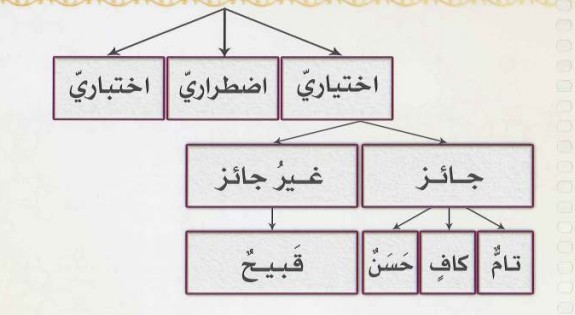
There are three divisions There are three divisions :
A-The Compelled Stop (الوقف الاضظرارى)
B-The Optional Stop (الوقف الاختيارى)
C– The Test Stop (الوقف الاختبارى)
A-The Compelled Stop (الوقف الاضظرارى)
This is what happens when the reader has a compelling reason for stopping such as shortness of breath, sneezing, coughing, disability, forgetfulness, and whatever is similar to these causes.
In these cases it is allowed to stop on the end of the word the reciter was at, even if the meaning is not complete.
After the compelling state has passed, the reader then starts with the word stopped on, and then joins it with what follows if it is a sound beginning; if not, the reader then should start back
one or two or more words, until they can start with what is sound for a beginning.
B-The Optional Stop (الوقف الاختيارى)
This is what was intended by the reciter by his own choice, without any outside reasons. This is the category of stopping that will be discussed in details , needs to be studied and applied in the correct way.
The optional stop is divided into four categories:
This is what is required of the student when being examined or taught by a teacher .The teacher may stop the student and correct him in a letter, in reading, in tajweed, or anything else that they feel needs correcting. The student stops when instructed to, and attempts to correct the mistake
In the Arabic language there is prohibition of two Saakin (non voweled) letters meeting, Except if they are present in one word and these two letters are pronounced in this case.
The second letter temporary Saakin due to stopping but if continuing reading it is read with its vowel.
رِجۡسٞ – [المائدة: 90].
In case of continuing : The Compulsory Lengthening
ٱلۡحَآقَّةُ– [الحاقة: 1]
ءَآلۡـَٰٔنَ – [يونس: 51، 91]
( قٓۚ ( ق: 1
Understanding the nuances of the ‘Two Saakin Letters Meeting‘ is crucial for beautiful recitation. In our structured Tajweed course, we break down each letter with live examples and personalized feedback from qualified instructors. Ready to perfect your recitation? Explore our Tajweed courses here:
When continuing recitation you will eliminate the two Saakin letters from being pronounced after each other either by dropping the first letter or acquire a vowel, By these two ways you prevent two Saakins from meetting.
Examples :
ءَامَنُواْ ٱتَّقُواْ– [المائدة: 35]
مِنَ ٱلشَّٰهِدِينَ – [الأنبياء: 56]
You choose the right way depending on what the first letter is:
1-Dropping Madd letter:
A-The alif dropped whencontinue recitation and pronounced the Fat-ha only
وَٱسْتَبَقَا ٱلْبَابَ – [يوسف: 25]
B-The yaa dropped when continue recitation and pronounced the Kasrah only.
فِي ٱلْأَرْضِ– [البقرة: 11]
C-The Waaw dropped when continue recitation and pronounced the Dammah only.
The Vowel acquired on the first letter saakin is Kasrah Except in three cases acquires dammah or fat-hah and the vowel is present on the first letter in the Mus-haf.
A-The first saakin Letter ذacquires kasrah and read with kasrah as it is in the Mus-haf.
وَبَشِّرِ ٱلَّذِين– [البقرة: 25]
B-The first letter saakin is waw leen و, It acquires when followed by saakin.
-The first Letter saakin ن acquires fat-hah read as it is in Mus-haf with fat-hah.
مِنَ ٱلشَّٰهِدِينَ– [آل عمران: 81]
الٓمٓ ٱللَّه – [آل عمران: 1]
3- To dammah :
The first letter saakin is the plural meem مOR plural waw و leen ,The meem or waw acquires a dammah.
لَكُمُ ٱلدَّارُ– [البقرة: 94]
وَعَصَوُا ٱلرَّسُولَ– [النساء: 42]
IF The first letter of the two saakin is the noon of the Tanween:
إِلَىٰ رَبِّكَ يَوْمَئِذٍ الْمُسْتَقَرُّ (12)
1-Surat Al-Qiyamah :12
The first letter saakin is the noon of the tanween and the second letter saakin is the LaamThe noon saakinah of the tanween is read with kasrah instead of the normal sukoon.
وَقَالَتِ الْيَهُودُ عُزَيْرٌ ابْنُ اللَّهِ 2- Surat At-Tawbah:30
📚 Did you find this article helpful? This is just the beginning.
Imagine having a qualified teacher to guide you, answer your specific questions, and provide a structured path to mastering the Quran.
At QuranMyWayAcademy, we move beyond articles to offer:
Live, Interactive Classes with certified teachers.
Personalized Learning Plans tailored to your age and level.
A Supportive Community of fellow students on the same journey.
Direct Feedback on your recitation and understanding.
Don’t just read about Islam; live it and understand it deeply.
It is defined ( Pressure on a part or a specific letter of the word, so that its sound is a little louder than that of the letter next to it . The accent varies from language to language, and from dialect to dialect. In the Glorious Qur’an the Nabr is noted.
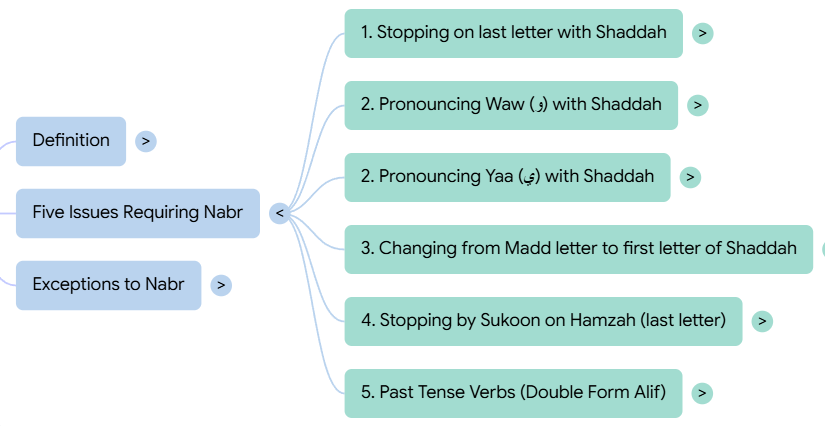
1-When stopping on a word that that has a shaddah on the last letter.
Examples : Stopping on Shadiah مُسْتَقِرٌّ– الْمَسِّ
The last letter of the word has a shaddah. We know that a shaddah on a letter ( indicates that the letter is divided in to two letters as far as formation of the letters goes.
The first is formed by collision of the two articulation bodies , where as the second is formed by separation of the two articulating bodies; this is when the reader is continuing reading and not stopping on the word.
When stopping on a word like this, we stop with one saakin letter, meaning this letter is formed by collision of the two articulating bodies. It is then as if one letter has been dropped from the reading.
Understanding ‘An Nabr‘ is crucial for beautiful recitation. In our structured Tajweed course, we break down each letter with live examples and personalized feedback from qualified instructors. Ready to perfect your recitation? Explore our Tajweed courses here:
2-This case occurs when pronouncing a ( و ) waw that has shaddah and the letter before has dammah or fathah .
Examples:أَوَّابٌ -This case occurs when pronouncing a ( ي) yaa that has a shaddah and the letter before has a kasrah or fat-hah Examples: وَجَاءَتْسَيَّارَةٌ
3-This occurs when changing over from a madd letter to the first letter of a shaddah.
The saakin letter occurs with collision and the mouth was busy emitting the lengthened letter, so then it is necessary at the change over from the madd to the saakin letter that occurs after it, putting an accent in our recital to facilitate this change over.
The saakin letter then makes its presence known quite clearly. If the collision is weak the letter is then pronounced with a weak sound to such a degree that it may not even be heard. Examples : الضَّآلِّينَ– ،دَآبَّةٍ – صَوَآفّ
5–When words of past tense verbs in the double form of the verb (which is an alif at the end of the word) read in continuation followed by a letter has sukoon.
Nabr(accent) is needed so the meaning of the verse is not confused. -Nabr(accent) is an indication that there is an alif indicating a double present, but it was dropped in pronunciation due to the Arabic rule forbidding two saakin letters next to each other to be recited together.
Without Nabr the listener may think the verb is male singular instead of male double.
At Quranmyway.com, we are built on this principle. We invite you to experience the difference by yourself. Visit our website, explore our courses, and book your free trial class today to begin your journey with confidence and peace of mind.
The exceptions to the Nabr :
A-in case of stopping on noon and meem with shaddah on them , these two letters with a shaddah have the most complete ghunnah .
The listener knows that there are two letters when he listens the long ghunnah .
Examples : ( فَامْتَحِنُوهُنَّ ).
B-Another exception, is stopping on a qalqalah letter that has a shaddah. When stopping on a word ending with a qalqalah letter with a shaddah, both letters of the shaddah are pronounced. Examples: بِالْحَقِّ – وَتَبَّ
The first بis pronounced with a sukoon and the second ب is pronounced with a qalqalah.
📚 Did you find this article helpful? This is just the beginning.
Imagine having a qualified teacher to guide you, answer your specific questions, and provide a structured path to mastering the Quran.
At QuranMyWayAcademy, we move beyond articles to offer:
Live, Interactive Classes with certified teachers.
Personalized Learning Plans tailored to your age and level.
A Supportive Community of fellow students on the same journey.
Direct Feedback on your recitation and understanding.
Don’t just read about Islam; live it and understand it deeply.
Quiz
1. Analyze the five cases where Nabr is applied. What is the common phonetic principle or challenge that Nabr addresses across these different scenarios?
2. Compare and contrast the two exceptions to the Nabr rule. Explain how the inherent phonetic qualities of ghunnah and qalqalah make the application of Nabr redundant in their respective cases.
3. Nabr is applied to a ‘waw’ (و) that has a shaddah when the preceding letter has a dammah or fathah. Similarly, it is applied to a ‘yaa’ (ي) with a shaddah when the preceding letter has a kasrah or fathah.
4. Nabr is defined as applying pressure on a specific part or letter of a word, causing its sound to be slightly louder than the adjacent letter. This accentuation is a noted feature of recitation in the Glorious Quran.
5. Explain how the articulation of madd and leen letters creates a phonetic environment where a subsequent hamzah or letter with a shaddah might be obscured. How does Nabr function as a corrective measure in these situations?
This is the first episode in this episode. I’ll cover what is the meaning of the Tajweed is one of the Islamic sciences . There are many Islamic sciences and one of them that’s related to the Quran.
How to read the Quran correctly, how to recite the Quran like Prophet Muhammed (PBUH) , how to pronounce the Quran correctly.
What is the meaning of that word (Tajweed) ?
It is Arabic word Means : improvement or betterment
Because when you know the rules of the Tajweed will be improved, your recitationtion will be Better
Allah said: وَرَتِّلِ الْقُرْآنَ تَرْتِيلًا (4) )
It’s mean recite the Quran slowly and clearly.
Let’s take example for important of learning Tajweed
We have Aarbic word. It’s called (قلب) means Heart and other word called (كلب)
If you don’t know Tajweed rules Maybe you mix between (قلب) and (كلب)because the both of these words have the same letter except (ق – ك ) and near from each other.
We pronounce ( كلب) instead of (قلب ) So if you don’t know that a Tajweed rules, maybe you Mix between it, So this is the reason to learn that with rules.
In the knowledge of scholars of recitation, is referring to recitation after cutting off recitation or stopping.
The beginning is only by choice, in contrast to the stop, which may be by choice or compulsion. For that reason it is demanded of the reader when beginning, that he start his recitation with an independent phrase that conveys the intended meaning, not attached to that which precedes it grammatically.
Its rule: It is allowed to begin with what comes after a complete or satisfactory stop under any circumstances, and allowed to start with that which comes after a good stop, only if it is the end of a verse ,This is only after Al-waqf (stop )not after al-Qat‟ )cutting off ( recitation).
The beginning can be divided into two types:
The allowed beginning الابتداء الجائز
It is starting with an independent phrase that has clear meaning ,The meaning that Allah desires, and does not contradict it.
2- The beginning that is not allowed الابتداء الغير جائز
It is the beginning that cancels out the intended meaning, or corrupts it, or changes it.
Many scholars divide Alibtidaa’ as alwaqf
The allowed beginning الابتداء الجائز
1-Complete تام
A-Any start of a surah
B- the start after a complete stop Examples:start with ayah no.6 in surat Al-Baqarah. انَّ الَّذِينَ كَفَرُوا سَوَاءٌ not attached to the previous ayah
2-Sufficient كاف
Example : start with ayah no. 7 in surat Al-Baqarah خَتَمَ اللَّهُ عَلَىٰ قُلُوبِهِمْ وَعَلَىٰ سَمْعِهِمْ ۖ وَعَلَىٰ أَبْصَارِهِمْ غِشَاوَةٌ Attached to the previous ayah in meaning.
Example: In surat As-Safaat aya 138 after stopping on the previous ayah وَإِنَّكُمْ لَتَمُرُّونَ عَلَيْهِم مُّصْبِحِينَ
And indeed, you pass by them in the morning.
– The two ayat attached grammatically and in meaning.
2- The beginning that is not allowed الابتداء الغير جائز
1-Repulsive قبيح
repulsive beginning would be when starting with a word that leads to a meaning other than that Allah, The Exalted, wants, or a meaning that is in disagreement with our creed
Example: Start with اتَّخَذَ اللَّهُ وَلَدًا سُبْحَانَهُ Allah has taken a son.” (Astaghfirullah)
Al waqf and Ibtida Part2 الوقف والأبتداء الجزء الثانى
Read: Part1 Part3 part4
3-The Good Waqf (stop ) الوقف الحسن
Its Definition: It is the stop on a Quranic word, complete in its meaning, but is attached to what follows it grammatically and in meaning.
It could be attached grammatically such as stopping on something that has a subsequent adjective, before the adjective. It could be stopping on a conjunctive sentence, without the conjunction and its following phrase.
Another possibility is stopping on an exceptional statement, without the exception.
The good stop can be found at the end of verses, or in the middle of verses, just as the other stops.
It is called “hasan” or good due to the fact that stopping on it leads to understanding of a meaning.
The rulefor the good stop: it is allowed to stop on it, but not allowed to start on what follows it due to its attachment to what follows grammatically and in meaning, except on the end of an aayah. Stopping on the end of an aayah is Sunnah.
You can stop on the word اللَّـهِ as the meaning in itself is fully understood.
In the name of Allah بِسْمِ اللَّـهِ
Than start الرَّحْمَـٰنِ الرَّحِيمِ
But you can‟t start with what comes next due to its attachment to what follows grammatically and in meaning.
-It is allowed to stop on it إِن تَمْسَسْكُمْحَسَنَةٌ تَسُؤْهُمْ
But it is better to continue reading وَإِن تُصِبْكُمْ سَيِّئَةٌ يَفْرَحُوا بِهَا
Its Definition: It is the stop on what does not give a correct meaning, and that is due to its strong attachment to what follows in grammar, and in meaning.
The rule for the repulsive stop:This stop not allowed intentionally. It is only allowed when compelled in such as a situation as unexpected shortness of breath, sneezing, or forgetting. After the state that compelled the stop has past, the reader then must repeat one, two, or more words, as necessary to convey the correct and sound meaning.
Do not stop on a verb without its subject (the doer of the verb).
Do not stop on a subject of a verb without the object of the verb.
Do not stop on a preposition without the object of the preposition.
Do not stop on a possessive noun ( possessed ) without the possession expression ( the possessor ) / two nouns the second is the possessive of the first noun (As in the “teacher’s book ” The word “teacher’s” is the possessor
and the book is the possessed).
Do not stop on the subject of the nominal sentence without the predicate – a nominal sentence in Arabic has no verb.
Do not stop on a word with is characterized without that which characterizes it.
Do not stop on a conjunction without its conjoined noun.
Do not stop on a noun which is in a state ( or case) without the word which gives the state (accusative).
So not stop on a number ( count) without that which is being counted.
And don’t stop on an emphasized noun without the emphatic term.
One of the most important areas in the science of Tajweed is knowledge of how to stop and begin recitation.
The understanding of Allah‟s words can‟t be appreciated ,nor correct understanding achieved without this knowledge .
Ibn Omar radia Allahu Anhu said “We spent a particular time when Iman (faith) would come to a person before Al-Qur’an and before a Soorah was revealed to the Prophet (blessing and peace be upon him), then we learned the halal and haram as well as the do’s and don’ts and what is suggested to be learnt/notified from it”.
First: Al Waqf (The stopping) الوقف
There are three divisions:
1-The Optional Waqf (Stop) الوقف الاختيارى
This is what was intended by the reciter by his own choice, without any outside reasons. This is the category of stopping that will be discussed in details , needs to be studied and applied in the correct way.
The optional stop is divided into four categories:
Complete تام
Sufficient كاف
Good حسن
Repulsive قبيح
2-The Compelled Waqf (Stop) الوقف الاضرارى
This is what happens when the reader has a compelling reason for stopping such as shortness of breath, sneezing, coughing, disability, forgetfulness, and whatever is similar to these causes. In these cases it is allowed to stop on the end of the word the reciter was at, even if the meaning is not complete.
After the compelling state has passed, the reader then starts with the word stopped on, and then joins it with what follows if it is a sound beginning; if not, the reader then should start back one or two or more words, until they can start with what is sound for a beginning.
3-The Test Waqf (Stop) الوقف الاختبارى
This is what is required of the student when being examined or taught by a teacher.The teacher may stop the student and correct him in a letter, in reading, in Tajweed, or anything else that they feel needs correcting. The student stops when instructed to, and attempts to correct the mistake.
THE OPTIONAL Waqf (STOP ) الوقف الاختيارى
1-The complete Waqf (stop ) الوقف التام
Its definition: It is the stop on a Quranic word complete in meaning and not attached to what follows it in grammatical expression or in meaning. If something is attached in meaning, it means that the preceding and following words are attached in meaning, but not necessarily attached in grammatical structure. This category of stop is usually found at the end of an ayah, and at the completion of stories in the Quran.
The rule for the complete stop: It is best to stop on the word that is a complete stop, and then start on what follows it.
Known in the Mushaf by the small meem sign مـ, shows that there is a must to stop , not stopping on this word could change the intended meaning of Allah‟s words.
Its definition: It is the stop on a Quranic word that is complete in meaning, and is attached to what follows it in meaning, but not in grammar. It can be at the end of a verse, or in a middle of a verse. It is called sufficient due to its lack of attachment grammatically to what follows, even though it is attached in meaning.
Its rule: It is advisable to stop on it and start with that which follows, just as in the complete stop.
The meeting Hamzatul Qta(همزة القطع) with Hamzatul Wasl (همزة الوصل).
Case 1: Hamza-t al-wasl preceding hamza-t al-qat‘ which is sakinah .
This only occurs in a few verbs, can be found in the following ayaat :
Examples:
-When we join the word preceding the word starting with hamzatul wasl, then the hamzah is dropped as we said before while hamzat alqat„ stayed fixed and is pronounced.
-When beginning any one of these verbs having a hamzat wasl as the first letter and a hamzat qat„ sakinah as the second letter, we begin with hamzat alwasl with the appropriate vowel, depending on the vowel of the third letter of the verb, After this, the hamzat alqat„ that immediately follows is changed in to a madd letter of the same category as the vowel we used on hamzat alwasl.If we start on hamzat alwasl with a dhammah then hamzat alqat„ becomes a lengthened waw (و)
آؤْتُمِنَ —->> آوتُمِنَ
More Examples: (آئْذن ) (آئْتوا )
This rule was previously discussed under the madd badl lesson, and it is as such: whenever two hamzahs meet, the first voweled, the second sakina, the second hamzah changes into a madd letter of the same type as the vowel on the first hamzah.
Case 2: The Questioning hamzat al-qata’ preceding hamzat alwasl:
Verbs:
Hamza-t alwasl is dropped in writing and pronunciation and hamza-t alqat„ of questioning remains.
-The words are pronounced exactly like they are written.
Nouns:
When a hamzat qat„ indicating a question enters a noun that has the definite article “alif laam at-ta’reef” (ال)attached at the beginning of it, hamzat alwasl undergoes changes, so that the
questioning hamzah can be distinguished from hamzat alwasl of the “alif laam atta’reef” .
Without a change in the hamzat alwasl, it would be impossible to determine whether there was a question before ال التعريف or not ,So hamzat alwasl is changed either one of the two following states.
Both of these ways of recitation are allowed.
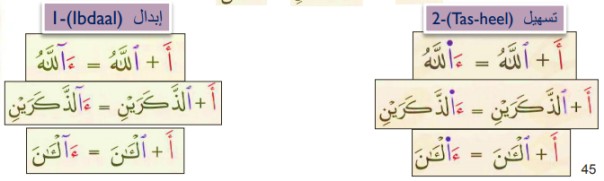
1-A lengthened alif ,This is called ibdaal أبدال
2-An “eased” hamzah ,This is called (heel-Tas ) تسهيل
Examples on verbs :
2 Ways of recitation are allowed in case of nouns :
1-Ibdaal أبدال
Its definition: When a hamzah indicating a question enters a noun that has the definite article ال التعريف
hamza-t alwasl of ال التعريف is changed into an lengthened alif which is lengthened six counts.
This lengthening is six vowel counts due to the sukoon on the lam after the long alif.The madd is laazim (compulsory madd) and is either “heavy” when followed by a shaddah, or “light” when there is a simple sukoon after the long alif.
2-Tas-heelتسهيل
Its definition: When a hamzah indicating a question enters a noun that has the
definite article ال التعريف hamza-t alwasl of ال التعريف is pronounced but “eased مسهله so that it is between a hamzah and an alif, with absolutely no madd.
Occurs in three words only in six places in the Quran.
You can find (hamzatul wasl) on:
1-Verbs الأفعال
2-Nouns الأسماء
3-Letters الحروف
2-The vowel of hamzat Alwasl when beginning with it in Nouns:
Always started with a kasrah
Hamzat Alwasl can be in regular or irregular in nouns and always
started with a kasrah.
-Hamzat AlWasl in Regular Nouns:
Original noun derived from five and six letter verbs.
-Original noun(مصدر(defined as A “noun” that points to the moment of occurrence.
-Original nouns that begin with hamzatul wasl are derived from either a five-letter verb that has
the same letter and vowel weight as أفتعلor a six-letter verb with the same letter and vowel weight as ْ أستفعل.
When these verbs are in the noun form, the third letter has a kasrah and an alif is added before the last letter.
-These nouns also will have a kasrah on hamza-t al-wasl when beginning on these words. If we are
reading these words connected with that which precedes it, we drop hamzatul wasl in pronunciation.
-It is found in ten specific nouns in the Arabic language, only seven of these are found in the Quran.
ابن ابنت اثنتين اثنين اسم امرأت امرؤ
Examples:
3-The vowel of hamzat Alwasl when beginning with it in Letters:
Always started with a Fatha
Hamza-t Alwasl can precede participles, more specifically, the definite article “the” ال التعريف
which is a laam لام – ال ) attached to a noun, preceded by a hamzat alwasl.
Hamza-t alwasl then beginning any noun beginning with the laam of the definite article “the” is read with a fath.
Example:
اللَّهُ – الْكِتَابَ
-Hamza-t Alwasl disappears in writing and in pronunciation in the definite article “the” ال التعريف of nouns when preceded by with a kasrah.
You can find (hamzaut wasl) on:
1-Verbs الأفعال
2-Nouns الأسماء
3-Participles الحروف
The vowel of hamza-t alwasl when beginning with it in verbs:
It is depend on the vowel on the third letter of the verb.
Note that shaddah is counted two letters (اتَّقُوا )here the third letter تon it fat-ha.
– There are two possible vowels when starting with hamza-t Alwasl in verbs they are the dammah or the kasrah. – Starting verbs with a dhammah on the hamza-t alwasl :
1-The hamza-t alwasl has a dhammah on it when beginning the word starting with it , if the third letter of the verb has an original dammah.
Examples of this in past tense verbs are shown in the following Ayaat: وَالرَّبَّانِيُّونَ وَالْأَحْبَارُ بِمَا اسْتُحْفِظُوا مِن كِتَابِ اللَّه – In Word اسْتُحْفِظُوا
The third letter تhas dammah therefore start this word with a dhammah on hamza-t alwasl. Remember, we only use hamza-t alwasl when starting the word.If we are reading in continue with the words before this verb, we would drop hamza-t alwasl.
C) When the third letter of the verb has a conditional or incidental or presented dhammah It is to be noticed that in these next six words the dhammah is a presented one due to the plurality of the command form.
امشوا-> its singular command form is امشِ and in the present tense يَمشِىwith kasrah on the third letter ش
اقضوا -> its singular command form is اقضِand in present tense يَقضِىwith kasrah on the third letter ض
Note:
When these verbs are the plural command form, there would have been a ya‟ sakinah
followed by a waw sakinah(madd letter) which is quite heavy for the tongue,So the Arabs drop the ya‟ sakinah in these forms of the verb,and the third letter acquires an dhammah) presented َضمة عارَضة
These are only five verbs in the Qur‟an that have a presented dhammah in the third letter, but it should be noted that some of these verbs occur in the Qur‟an in different forms of the same verb.
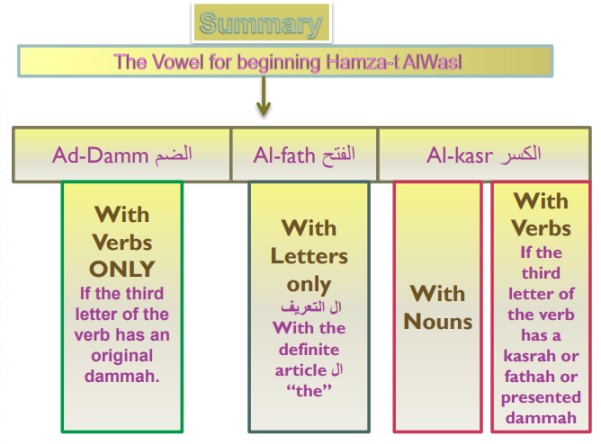
Summary:
With a KasrahWhen the third letter of the verb:
1-has a kasrah.
2-has a fat-ha.
3-has a presented dammah.
With a dhammah When the third letter of the verb has an original dammah.
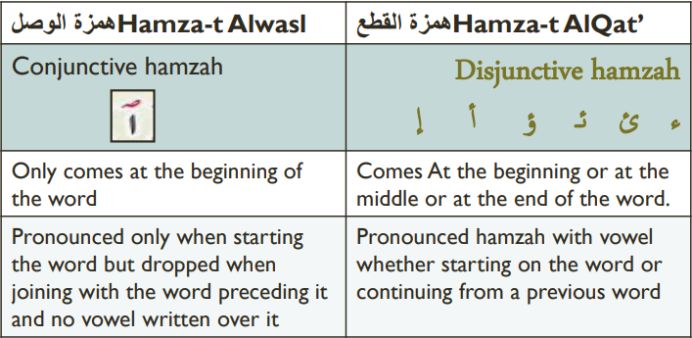
It is established that the reader of the Qur’an must start reciting with a voweled letter, never a sukoon.It is also an established fundamental of reading the Qur’an that stopping is always with a sukoon on the last letter that is recited, Some words are not written with a vowel on the first letter,
And, as stated starting a word with a sukoon is not allowed. In this case an extra hamzah is put on the beginning of the word.This is called Hamzah Alwasl (pronounced Hamza-t Alwasl), and is used to connect it ( to the point of a sukoon that is present at the beginning of the word. Hamza-t alwasl looks like an alif with a little head of ص over , was taken from the word (salah).
The Definition of Hamzaut Alwasl :
It is an extra hamzah at the beginning of the word, established (pronounced) when starting, dropped when continuing.
Examples: ( الحمدُ لِلَّه – وَإِذَا الرُّسُلُ )
All hamzaut alwasl in these words are dropped when continuing (when joining the word with the word preceding it), and are established when starting (starting with the word).
It is called hamzaut wasl همزة الوصل because connects or joins to a point with a sukoon .
Tajweed Advanced Course (Part 3) The meeting of two letters Part 3 (Small-Big-absolute)) (الحرفان الملتقيان الجزء الثالث (الصغير – الكبير- المطلق
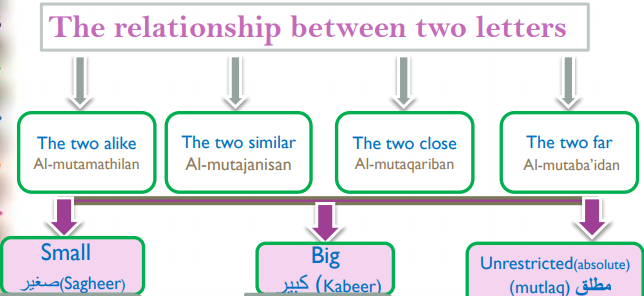
Each one of the Four relationships between two meeting letters divided into three divisions according to the vowels on each of the two letters:
1-Small (Sagheer) الصغير
The first letter is saakin, and the second letter is voweled,It is called small because of its ease and the little effort required in applying it in case of idgham.
2-Big (Kabeer ) الكبير
The two letters next to each other have a vowel, It is called big because of the greater effort required in applying it in case of idgham.
3-The first letter of the two letters has a vowel, and the second letter has a Sukoon. It is called unrestricted. المطلق
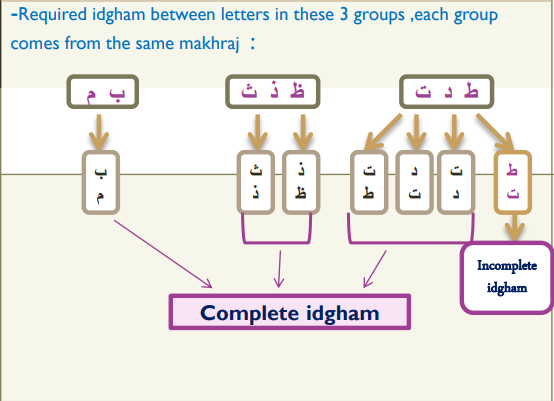
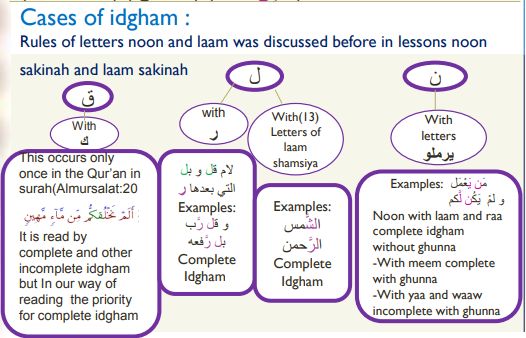
– Idgham can either be complete or Incomplete.
Kinds of Idhgham:
Complete Idgham: There is absolutely NO trace of the saakin letter during pronunciation.
Shaddah is present on the letter that is being merged into Example:
( قُل رَّبِّي ) With ghunna.
( إِن نَّشَأْ) Without ghunna.
Incomplete Idgham: there is SOME trace of the saakin letter during pronunciation , and also have SOME trace of its characteristics.
No shaddah present on the letter that is being merged into, Example: ( أحطتُ)
Go Deep into Idgham
Linguistic definition of Idgham is: Insertion or merging.
The applied tajweed definition is :The meeting of a non-Voweled (saakin) letter with a voweled (mutaharrik) letter ,so that the two letters become one emphasized letter of the second type.
NOTE:The sukoon is not drawn in Mushaf (Quran book( on the lettersakin in case of idgham ,the sukoon being drawn above the letter in case of idhhar.
In case of Idgham with ghunna: ghunnah is NOT pronounced (except for he letters meem and noon ,as ghunnah is ALWAYS pronounced for these 2 letters when they carry a shaddah).
Tajweed Advanced Course (Part 2) The meeting of two letters Part 2 (alike-Similar-Approximates-Far) (الحرفان الملتقيان الجزء الثانى (المتماثلان – المتجانسان- المتقاربان-المتباعدان
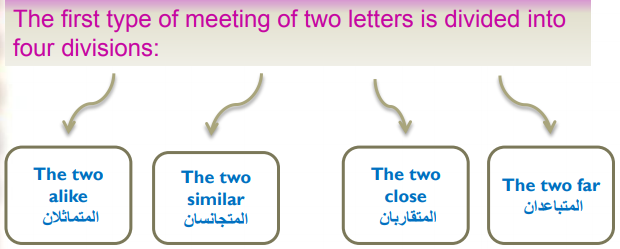
1-The two alike (The Two Like Each Other) ِAl-Mutamathilan المتماثلان
Definition: They are the two letters that are the same in the characteristics(sifat) and in the articulation point (makhraj).
This means they are the exact same letters next to each other. Examples of this are: ( حَيْثُ ثَقِفْتُمُوهُمْ (ث – ث) —- اذْهَب بِّكِتَابِي (ب– ب
Notes: When two waaw or two yaa next to each other in writing but one of the two letters are madd letter such as: آمنوا وعملوا Or الذي يوسوس
So we then have a natural lengthening, the next letter following this letter madd with a vowel on it ,madd letters not merging into non-madd letters of the same type.
2-The two Similar (The Two Of Similar Nature) Al-Mutajanisan المتجانسان
Definition: They are the two letters that have the same articulation point, but differ in some characteristics. They can be
In one word as in: ( أَمْوَالُكُمْ ( م – و both letters from lips.
Or in two words as in: (هَمَّتْ طَائِفَتَانِ (ت – ط both have same Makhraj from the top side of the tip of the tongue and the gum line of the two front incisors.
3-The two Close (The Two Approximates to Each Other) Al-Mutaqariban المتقاربان
Definition: It is the two letters which are close in the articulation point and the characteristics or close in the articulation point but not in the characteristics or close in characteristics but not in the articulation point .
From this definition it is clear that there are three different ways that two letters can be classified as two close .
-There is a difference in opinion in the meaning of the two letters involved , the most important opinions are : A-That there is no separation between the articulation parts of the two letters .instead they should use the same articulating part (i.e. the tongue); or if they use two different articulation parts ,there is no separation between the two parts (as in the lips and the tip of the tongue).
B-The approximation of the two letters is a relative approximation ,whether they use the same articulation part or not .This opinion is used most when the two letters have closeness in characteristics ,but not articulation points.
An example of close in articulation and characteristics is the “laam” and “raa” in (قالَ رَب) These two letters have different articulation points but they are quite close to each other and they share all characteristics except the “Tikrar” )repetition ( it is just in raa .
Another example : taa and thaa in (وَالنُّبُوَّةَ ثُمَّ ) they have different articulation points but close to each other and share most characteristics except (taa) has shiddah and (thaa) has rakhawa.
An example for letters close in articulation but not in characteristics . ( عَدَد ِسنٌين ) seen and daal the are.
An example of letters close in characteristics ,they share all characteristics but are not close in the articulation points are the daal and jeem in the words (داود جالوت)
4-The Two Far (The Two Far From Each Other) ِAL-Mutaba’idan المتباعدان
Such as :
Each one of the Four relationships between two meeting letters divided into three divisions according to the vowels on each of the two letters.
Tajweed Advanced Course (Part 1) The meeting of two letters Part 1 (introduction) (الحرفان الملتقيان الجزء الاول (المقدمة
The study of the relationships between letters when they meet in writing and pronunciation is important in determining whether the first letter is pronounced clearly or whether possibility or even a requirement of the first letter merging into the second.
So we have to learn which letters can merge with others and under which circumstances.
There are four possible different categories that the two meeting letters can fall under, These categories will be discussed further bi-idhnillah .
The meeting of two letters is of three different ways:
Meeting of the two in pronunciation and writing, in that there is no separation between them, such as the two “ب baa“ وَلَا يَغْتَب بَّعْضُكُم Such as the two laam هل لكم
Meeting of the two in writing only, such as in: (سَمِيعٌ عَلِيمٌ – إِنَّهُ هُوَ ) here the two haaare next to each other but maddas-silahprevents them from being pronounced together by the way we read (Hafs An Aassim).
– Meeting of the two in pronunciation only in as: أَنَا النَّذِيرُ In this case the alif separates the two noon from each other, but since the alif is not pronounced, the two noon meet in pronunciation.
The first type is what will be discussed , the second and third type do not enter this section or do not
apply to the way we read.
When discussing the relationship of two letters that meet, it does not matter whether they meet in one
word or are in two different words, and the letters meet each other by one being at the end of a word and the other at the beginning of the next word.