Makharij al Huruf ( ع – ح – خ )

Makharij al Huruf ( ع – ح – خ )

Why focus on these Letters ( ع – ح – خ ) ?

– Most of non Arabic speakers mix Between (ع – ء) , (ح – هـ) , (خ – غ ).

– Near of Makharij (the place of emitted of letter) or articulation point between (ع – ء) , (ح – هـ) , (خ – غ ) , We will see in this lesson .

– Some Languages don’t have sound of (ع – ح  – غ) , Therefore they cannot define the difference between ( ء – ه – خ) and them .

For these reasons and more it’s better to focus on these Letters t improve your recitation inshallah.

The Makharij  of (ع – ء) , (ح – هـ) , (خ – غ )
Makharij al Huruf-1235

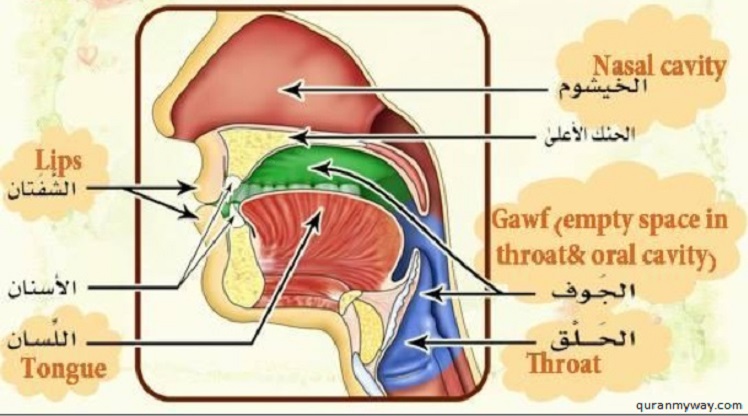
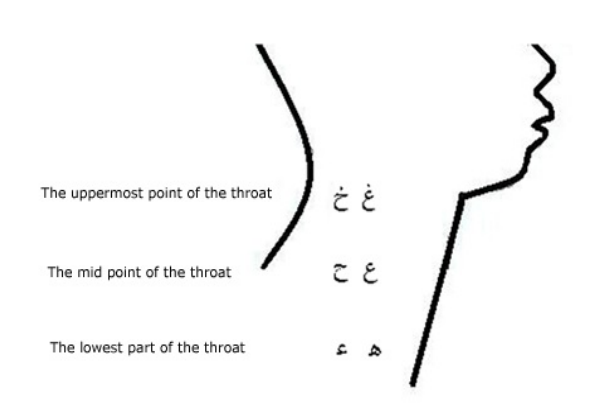
As you see in the Picture Al Halq  ( The throat )    الحلق

In the throat there are 3 Makhaarij and each one has 2 letters: َ

  1. Aqsal halq  (أقصى الحلق ) Deepest part of Throat – is pronounced (ءَ – هــ)
  2. Wasatal halq ( وسط الحلق ) Middle part of Throat – is pronounced ( ع – ح)
  3. Adnal halq  (أدنى الحلق ) closest part of Throat – is pronounced (  غ – خ )

Book Free Trial & Start your journey of Quran, Arabic, and Islam e-Learning today

Quran Courses

How can pronounce ( ع ) and ( ء )

Hamzah (ء) comes from deepest part of Throat but  Ain (ع) comes from Middle part of Throat .

Hear to this Audio :


Hear to these examples and try to pronounce all of it :

For Hamzah (ء) – ( فأس ، يأذن ، يأتي ، مأذون ، تأنيب ، تلألأ ، مأخذ , مؤلم ، مؤتمر )


For Ain (ع) –  ( عَنْكَبُوت – عُصْفُور –  عِنَب  – عِظَام- عَقل ,  ثُعْبَان –  ثَعْلَب – مِلْعَقَة  ,  ذِرَاع –  مَصْنَع –  بَائِع  – رَائِع )

learn quran free

Start Free Trial

How can pronounce ( ح ) and ( هـ )

(هـ) comes from deepest part of Throat but  Ain (ح) comes from Middle part of Throat .

Hear to this Audio :


Hear to these examples and try to pronounce all of it :

For (هـ) : ( هضم، هناء، هواء، هرم , شهر، دهر، جهل، زهر , أفواه، مكواه، مياه، نواه )


For (ح) : (حرف – حلق – حب –  صحف – سحاب – صاحب – محمد , شرح – نبح – مسح  )

Learn Surah Al Ikhlas with Tajweed Rules

How can pronounce ( غ ) and ( خ)

(غ – خ ) Come from the same place closest part of Throat near of Tongue .

Hear to this Audio :


Hear to these examples and try to pronounce all of it :

For (غ) : (غادة، غبن، غرور , رغوة، رغبة، لغة، اغلاق , صبغ، لدغ، فراغ)


For (خ) : (خالد، خاتم، خيار , مخبأ، مختبر، مخبز , مريخ، شيخ، مخ)

→ Who Is Putted Tajweed

→ Tuhfat Al Atfal Matn part 9 – The Types of Madd Lazim

Makharij al Huruf part 4

Makharij al Huruf part 4

Tajweed Course for beginner Part-23

Makharij al Huruf  Or Articulation Points part 4          مخــارج الحـروف الجزء الرابع

Read :  Part1  Part2  Part3

There are Five major five Makhaarj :

  1. Al Jawf ( The oral cavity )    الجوف
  2. Al Halq  ( The throat )    الحلق
  3. Al Lissaan ( The tongue )   اللسان
  4. Ash-shafatain ( The lips )    الشفتان
  5. Al Khayshoom ( The nasal cavity )     الخيشوم

4-  THE LIPS ( AL-SHAFATAYN ) الشفتين

This is a general region, which has two specific points of articulation. And has 2 sub-categories :

1. When one lip is used: ف  The edge of the upper front teeth meet the in side lower lip (the wet part) ( افْ )

2. When two lips are used: ( ب  م  و ):

THE TWO LIPS ( AL-SHAFATAYN )1

( ب ) Pronounced by pressing the lips together firmly and quickly. Similar to the letter but there is more of a bounce as you press the lips then quickly release them again (ابْ)

( م ) Pronounced by the meeting of the dry outer parts of the lips, and pushing air through the nasal passage (امْ)

(و) This is not the ( و ) of elongation from the jawf. This letter wi ll carry a harakaat. It is pronounced by the incomplete joining of both lips  (او)

THE TWO LIPS ( AL-SHAFATAYN )2

5- THE NASAL CAVITY ( AL-KHAYSOOM )  الخيشوم

The nasal cavity is located at the furthest point of the nose (the bridge of the nose). It is the opening that connects the mouth with the nose. This connection is where the ghunnah exits. The ghunnah is a sound that is resonated and the tongue is not used to produce it . The duration of the ghunnah sound is for 2 counts:
learn quran free

Start Free Trial

The ghunnah is produced in the following cases:  ( ن – م )

  • This is the articulation point for ghunna (nasal sound).
  • Ghunnah is a characteristic of Noon and Meem prevalent more when they have a shaddah on them.
  • We also use the sound of ghunna in the noon sakinah and tanween rules and meem sakinah rules.
  • The length of Ghunnah differ according to the rule applied of Noon or Meem.

Note:

Ensure that the following letters are differentiated and pronounced correctly:

THE NASAL CAVITY ( AL-KHAYSOOM )


Put any question in comment

Our Blog

Our Courses

READ MORE POSTS:

tafseer-course-online
surah-fatiha-names
al-waqf-and-ibtida-part1

Makharij al Huruf part 3

Makharij al Huruf part 3

Tajweed Course for beginner Part-22

Makharij al Huruf  Or Articulation Points part 3             مخــارج الحـروف الجزء الثالث

Read :  Part1  Part2  Part4

There are Five major five Makhaarj :

  1. Al Jawf ( The oral cavity )    الجوف
  2. Al Halq  ( The throat )    الحلق
  3. Al Lissaan ( The tongue )   اللسان
  4. Ash-shafatain ( The lips )    الشفتان
  5. Al Khayshoom ( The nasal cavity )     الخيشوم

3- THE TONGUE ( AL-LISAAN )     الـلســان

Many letters come from the mouth: that is the tongue and its connection with the different areas of the teeth and mouth
There are 4 main makhaarij that can be divided into 10 sub-categories

  1. The furthest back part of the tongue – this has 2 sub categories
  2. The middle of the tongue – this single makhraj covers 3 letters
  3. The side of the tongue – this has 2 specific points of articulation
  4. The tip of the tongue

Makharij al Huruf exampl1

1-The furthest back part of the tongue – this has 2 sub categories

ق  is pronounced by the extreme back of the tongue touching the upper palate to create a thick sound in the tonsils vicinity, with a round sound  (اقْ)

ك  The makhraj is slightly in front of the ق This time the tongue should not meet the upper palate other than what is necessary to pronounce the letter. So the sound still comes from the back of the tongue, except this time the tongue is not elevated ( اكْ )

2-The middle of the tongue – this single makhraj covers 3 letters

( ج  ش and  ى ) These are all pronounced when the middle part of the tongue comes in contact with what lies opposite to it from the roof of the mouth

Makharij al Huruf part 3 example3

3-The side of the tongue – this has 2 specific points of articulation

ض The rear side of the tongue touches the upper back teeth (upper molars) in either one of 3 ways : from the right side, from the left side OR from both sides. The left side of the tongue is most commonly used as it is easier than the right, (اضْ)

ل  It’s articulation point is the side of the tongue nearest the front of the mouth and the tip of the tongue, and what lies opposite to it of the gums of the first two upper premolars, the two upper canines, the two upper lateral incisors, and the two upper front incisors. ( الْ )

ر  Located behind the makhraj of the  ن  – ارْ
learn quran free

Start Free Trial

4-The tip of the tongue

It has 5 articulation points with 11 Letters.
1 – (ن).
2- (ر).
3- ( د ط ت ).
4- ( ص س ز ).
5- ( ظ  ذ ث ).

ن  From the tip of the tongue and what is parallel to it of the gums. It is slightly below the makhraj of laam It’s nasal sound originates from the Nasal Cavity ( ان )

ر  From the tip of the tongue and a little from the edge of the tip And what is parallel to it of the gums of the upper front teeth. The tongue is raised from the back for a heavy ر

( ط  د  ت )

These letters pretty much come from the same place – the difference between them is slight but important. The tip of the tongue meets the base of the top front teeth (place where the gums and teeth meet):

ت Is most forward and exact at the poin t where the gums and teeth meet ( اتْ )

د Is a little further back  ( ادْ )

ط Is behind the د a little. The back of the tongu e should also meet the upper palate as it is a thick letter ( ادْ )

( ز ص س ) 

س The tip the tongue should meet the place where the gums and lower teeth meet. You should allowthe flow of air in the mouth to pass from the back to the front and exit from between the teeth (  اسْ )

ص The back of the tongue elevates to meet the the upper palate as it is a thick letter   ( اصْ  )

ز  For this letter, the teeth should be pressed together that the air passage sounds like a buzzing sound ( ازْ )

( ظ  ذ ث  )  the tip of the tongue meets the edge of the front upper teeth:

ظ  is articulated by putting pressure on the edge of the roots of the upper incisor teeth. The back of the tongue elevates to meet the upper palate as it is a thick letter   ( اظْ )

ذ  is articulated by putting pressure o n the mid-section of the 2 upper incisor teeth  (  ا ذْ )

ث  is articulated by putting pressure o n the edge of the 2 upper incisor teeth ( ْاث )

Makharij al Huruf part 3 example2


Put any question in comment

Our Blog

Our Courses

READ MORE POSTS:

learn-quran-with-tajweed
surah-nas-translation-tafseer
lam-sakinah-rules

Makharij al Huruf part 2

Makharij al Huruf part 2

Tajweed Course for beginner Part-21

Makharij al Huruf  Or Articulation Points part 2             مخــارج الحـروف الجزء الثانى

Read :  Part1  Part3  Part4

There are Five major five Makhaarj :

  1. Al Jawf ( The oral cavity )    الجوف
  2. Al Halq  ( The throat )    الحلق
  3. Al Lissaan ( The tongue )   اللسان
  4. Ash-shafatain ( The lips )    الشفتان
  5. Al Khayshoom ( The nasal cavity )     الخيشوم

1-Al Jawf ( The oral cavity )   الجوف

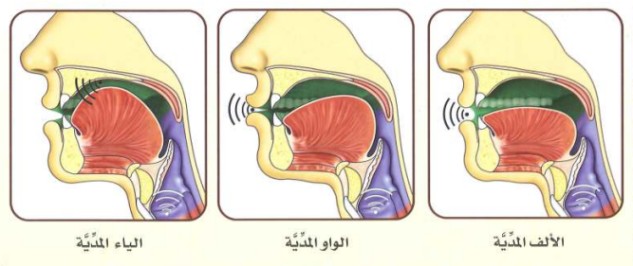
This is all the empty space that occurs from the chest, up the throat and out through the mouth. It is the makhraj of the long vowels sounds (also known as the elongated letters) and is elongated for 2 counts:

-AL- JAWFََ

These three madd letters do not have a specific space that they finish at like other letters do, Instead these letters finish with the stopping of the sound.
A- ( ى ) The ya’ with sukoon preceded by a letter with kasrah (The vocal cords are open, and the middle of the tongue is raised close to the makhraj of the letter ya)

B- ( و )  The wow with sukoon preceded by a letter with Dammah (The vocal cords are open, and the lips are rounded in the same shape as if we were saying the letter wow.)

C- ( ا )  The Alif with a sukoon preceded by a letter with Fathah (The vocal cords are open. The back of the tongue is lowered for the light alif, and the back of the tongue is raised for the heavy alif.)
learn quran free

Start Free Trial

Note:

  • in the Qur’an, the sukoon may not always be shown on the letter, but as a general rule, whenever a letter does not carry a vowel, it means that it has a sukoon, even if it is not actually present .
  • These letters are also found in the Quran (“نُوحِيهَا“)

2-Al Halq  ( The throat )    الحلق

In the throat there are 3 makhaarij and each one has 2 letters:

Makharij al Huruf-1235

  1. Adnal halq  (أدنى الحلق ) closest part
  2. Wasatal halq ( وسط الحلق ) Middle part
  3. Aqsal halq  (أقصى الحلق ) Deepest part
  • The deepest part of the throat ( أقـصـى الحـلـق )means the farthest part from the mouth and closest to chest) from here two letters are articulated     ءَ  هــ
  • The middle part of the throat (  وســط الحــلــق ) where two letters emerge َ ع  ح
  • The closest part of the throat ( أدنى الحــلـق ) means the closest to the mouth) from here two letters emerge  غ  خ

Put any question in comment

Our Blog

Our Courses

READ MORE POSTS:

learn-ten-qiraat-onlin
4-tips-on-how-to-learn-arabic-successfully
rules-of-noon-meem-mushadadh

Makharij al Huruf part 1

Makharij al Huruf part 1

Tajweed Course for beginner Part-20

Read :  Part2  Part3  Part4

The Makhaarij of the Letters ( ARTICULATION POINTS )   مخــارج الحـروف

Definition : Makhaarij is the plural of makhraj.

It is the place of emitting the letter when pronouncing it that differentiates that specific letter from other letters.

It means:

The correct position of the organs of speech in order to produce a letter so that it can be differentiated from others.
This is equally so whether the letter is a consonant or a vowel.

Understanding the nuances of the ‘Makharij al Huruf‘ is crucial for beautiful recitation. In our structured Tajweed course, we break down each letter with live examples and personalized feedback from qualified instructors. Ready to perfect your recitation? Explore our Tajweed courses here:

Start A Free Trial

Being able to recite the letters correctly is the foundation of Tajweed, and this is achieved by knowing where the sound originates. This can then help in practising the pronunciation of the letters correctly.

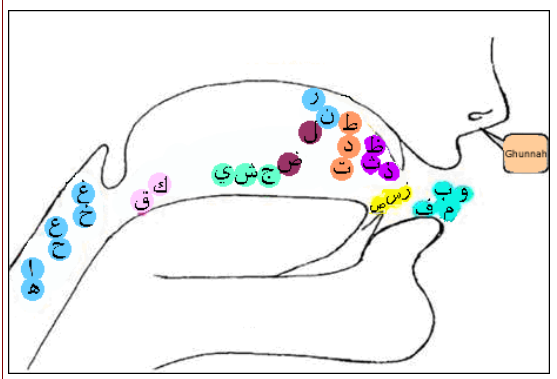
The diagram below gives a snapshot of where each letter originates :

Makharij al Huruf

  ⇒ We Have Course For Explain  Makharij al Huruf See New offer ⇐

How ever:

  • Makhaarij must be used hand in hand with Sifaat (characteristics of the letter) in order to pronounce the letter completely and correctly, as the Makhraj provides the origin and the Sifaat provides extra information required to pronounce the letter properly.
  • To achieve the correct makhraj of a letter, practise via placing a sukoon ( ) on it, and precede it with an alif / hamzah with a kasrah ( )
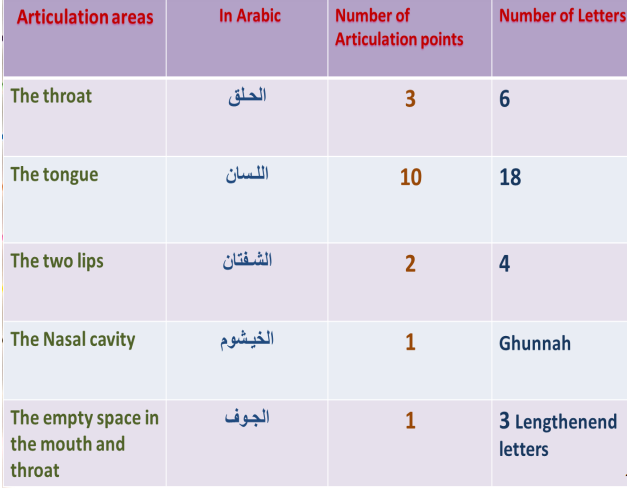
  • There are 5 main categories of Makhaarij (or Five major areas of the human body are used to pronounce different letters.)
  • These Five major area divided into 17 different articulation points to pronounce the 28 original letters and the Madd letters.

There are Five major five Makhaarj :

  1. Al Jawf ( The oral cavity )    الجوف
  2. Al Halq  ( The throat )    الحلق
  3. Al Lissaan ( The tongue )   اللسان
  4. Ash-shafatain ( The lips )    الشفتان
  5. Al Khayshoom ( The nasal cavity )     الخيشوم

Makharij al Huruf Or Articulation Points

Book Free Trial & Start your journey of Quran, Arabic, and Islam e-Learning today

See our Courses

TYPES OF ARTICULATION POINTS :

  1. SPECIFIC ARTICULATION POINT :  Relies on specific place of the areas of the tongue, throat or lips.
  2. APPROXIMATE ARTICULATION POINT:  Does not rely on specific place of the areas of the -tongue, throat or lips . The approximate articulation point is applied to the lengthened letters that come from the empty space in the mouth and throat.

Makharij al Huruf

Scholars differ

Imam Ash-Shatibi and Sibaway said there are 16 points of articulation, and did not count the Jauf as a point of articulation.

Still other scholars of Arabic language said there are 14 points of articulation, as they did not count the Jauf, and were of the opinion that ر ن ل share the same makhraj.

Will be continued..

📚 Did you find this article helpful? This is just the beginning.

Imagine having a qualified teacher to guide you, answer your specific questions, and provide a structured path to mastering the Quran.

  • At QuranMyWay Academy, we move beyond articles to offer:
  • Live, Interactive Classes with certified teachers.
  • Personalized Learning Plans tailored to your age and level.
  • A Supportive Community of fellow students on the same journey.
  • Direct Feedback on your recitation and understanding.
  • Don’t just read about Islam; live it and understand it deeply.

Start A Free Trial

Our Blog

Our Courses

READ MORE POSTS:

islamic-history
the-mudood-lengthenings-part-5
mistakes-in-tajweed-rules