Arabic numbers for beginners

Arabic numbers for beginners

Arabic Numbers for Beginners: A Complete Guide (1 to 100+)

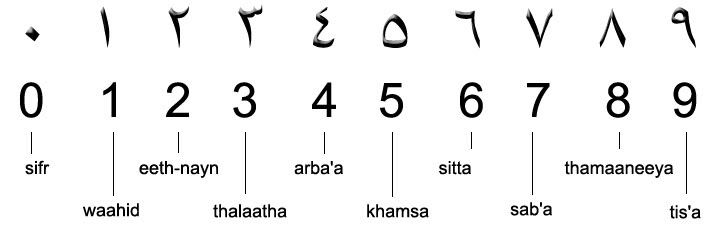
How to write the numbers themselves. In most of the Arab world, they don’t use 1, 2, 3 as we do in the West. They use their own numerals: ٠, ١, ٢, ٣, ٤, ٥, ٦, ٧, ٨, ٩.

The Words: How to say the numbers. For example, the word for “one” is واحد (Wahid), and “two” is اثنان (Ithnan).

Arabic Numbers Table:

0                       Sifir                                        30                       Tlateen
1                       Wahid                                    40                       Ara’been
2                       Itnaym                                   50                       Khamseen
3                       Talaata                                   60                       Sitten
4                       Arb’a                                     70                        Sebeen
5                       Khamsa                                 80                        Tamannen
6                       Sitta                                      90                         Tiseen
7                       Sab’a                                    100                        Miyya
8                       Tamanya                              101                        Miyya wa-wahid
9                       Tes’a                                     150                        Miyya Khamseen
10                     Ashra                                   200                        Mitayn
11                     E-Daish                                500                        Khamsa Miyya
12                    Tnish                                    1000                       Alf
13                    Tletaish                                2000                      Alfayn
14                    Arb’ataish                           3000                       Talaat Alaaf
15                    Khamistaish                       100000                    Meet Alaaf
20                    Ashreen                              Million                    Millyoun
1/2                  Nous                                  1/4                            Robah

Book Free Trial & Start your journey of Quran, Arabic, and Islam e-Learning today

Quran Courses

Learn Arabic Numbers: A Step-by-Step Guide for Beginners

At first glance, Arabic numbers might look intimidating. The squiggles and curves seem completely foreign to an English speaker. But here is the secret that changes everything: the numbers you already use every day (1, 2, 3) are actually Arabic numerals.

That’s right. The numeral system we call “Arabic” in the West (1, 2, 3) originated in North Africa. Meanwhile, in the Middle East, they use a different set of symbols (١, ٢, ٣).

The good news? Both systems are easy to learn if you take it step by step. Let’s begin.

Step 1: The Two Systems – Don’t Get Confused

Before you learn a single number, you need to know which “version” of Arabic numbers you are learning.

  • Western Arabic Numerals (What you already know): 1, 2, 3, 4, 5… (Used in most math and Western contexts).

  • Eastern Arabic Numerals (Used in the Arab world): ١, ٢, ٣, ٤, ٥…

For this guide, we will focus on the Eastern Arabic numerals used in newspapers, street signs, and markets in countries like Egypt, Saudi Arabia, and the UAE.

Value Eastern Arabic Western Arabic
0 ٠ 0
1 ١ 1
2 ٢ 2
3 ٣ 3

Step 2: Master the Digits 0 to 9

Your first goal is to connect the symbol to the sound. Practice writing these while saying the Arabic word out loud.

  • 0 – صفر (Sifr) – From this word, we get the English word “zero” and “cipher.”

  • 1 – واحد (Waaḥid)

  • 2 – اثنان (Ithnān)

  • 3 – ثلاثة (Thalātha)

  • 4 – أربعة (Arbaʿa)

  • 5 – خمسة (Khamsa)

  • 6 – ستة (Sitta)

  • 7 – سبعة (Sabʿa)

  • 8 – ثمانية (Thamāniya)

  • 9 – تسعة (Tisʿa)

Pro Tip: The letter ʿ represents a “guttural stop” – a sound not found in English. Think of the catch in your throat when you say “uh-oh.”

Book Free Trial & Start your journey of Quran, Arabic, and Islam e-Learning today

Quran Courses

Step 3: Count from 10 to 99 (The Easy Pattern)

Here is where Arabic becomes logical. Numbers 10-19 are unique, but once you hit 20, it’s a simple formula: Tens + and + Ones.

The Teens (11-19)

To say 15, you say “five-ten” (khamsa-ta’ashar). Notice the word for ten changes slightly.

  • 10 – عشرة (ʿAshara)

  • 11 – أحد عشر (Aḥad ʿashar)

  • 12 – اثنا عشر (Ithnā ʿashar)

  • 13 – ثلاثة عشر (Thalāthat ʿashar)

  • 20 – عشرون (ʿIshrūn)

The 20s, 30s, and beyond (20-99)

Learn the tens, then simply add the unit.

The Tens:

  • 20 – عشرون (ʿIshrūn)

  • 30 – ثلاثون (Thalāthūn)

  • 40 – أربعون (Arbaʿūn)

  • 50 – خمسون (Khamsūn)

  • 60 – ستون (Sittūn)

  • 70 – سبعون (Sabʿūn)

  • 80 – ثمانون (Thamānūn)

  • 90 – تسعون (Tisʿūn)

To build a number: Say the ten, then the word wa (and), then the unit.

  • 25 = 20 + 5 = ʿIshrūn wa khamsa (عشرون و خمسة)

  • 47 = 40 + 7 = Arbaʿūn wa sabʿa (أربعون و سبعة)

  • 82 = 80 + 2 = Thamānūn wa ithnān (ثمانون و اثنان)

Step 4: The “Gender Flip” Rule (The Tricky Part)

This is where beginners usually give up, but don’t worry. Here is the rule in plain English:

For numbers 3 to 10, the number’s gender opposes the noun’s gender.

  • Arabic nouns are either masculine or feminine.

  • The word for “car” (sayyara) is feminine. So you use the masculine form of the number.

  • The word for “book” (kitāb) is masculine. So you use the feminine form of the number.

Example:

  • Three books (masculine noun) → Thalāthatu kutub (Use feminine form: Thalāthat)

  • Three cars (feminine noun) → Thalāthu sayyarātin (Use masculine form: Thalāth)

Don’t memorize the grammar now! Just be aware it exists. For your first month, people will understand you even if you get this wrong.

Start A Free Trial

Step 5: Hundreds, Thousands, and Big Numbers

Arabic builds big numbers exactly like English, reading from largest to smallest.

Hundreds:

  • 100 – مائة (Miʾa)

  • 200 – مئتان (Miʾatān)

  • 300 – ثلاثمائة (Thalāth miʾa) – literally “three hundred”

  • 1,000 – ألف (Alf)

Read this number: 1,245
Alf wa miʾatān wa khamsa wa arbaʿūn (One thousand, two hundred, five and forty).

Notice the order is: Thousands → Hundreds → Tens → Ones.

Step 6: Practical Use (Phone Numbers & Prices)

You don’t need to be a mathematician to speak Arabic. Focus on real-life situations.

Phone Numbers: Say each digit individually, just like in English.

  • 010 234 5678 → Sifr waaḥid sifr, ithnān thalātha arbaʿa, khamsa sitta sabʿa thamāniya

Prices at a market:

  • “How much?” = Bikam?

  • “Five” (hold up 5 fingers) = Khamsa

  • “Twenty” = ʿIshrīn

Time:

  • 3:00 = Al-sāʿa al-thālitha (The third hour)

  • 7:15 = Al-sāʿa al-sābʿa wa rubʿ (The seventh hour and a quarter).

Your 7-Day Practice Plan

  • Days 1-2: Write the symbols ٠ to ٩ ten times each. Say the word aloud every time you write.

  • Day 3: Count objects in your house (pens, spoons, windows) from 1 to 20.

  • Day 4: Learn the tens (20-90). Create flashcards.

  • Day 5: Practice phone numbers from your contact list. Read them aloud in Arabic.

  • Day 6: Go to a market (or online store) and say the prices out loud.

  • Day 7: Write out your birth year (e.g., 1990) and your house number in Arabic script.

Start today: Write your own phone number in Eastern Arabic numerals. You have just taken step one.

📚 Did you find this article helpful? This is just the beginning.

Imagine having a qualified teacher to guide you, answer your specific questions, and provide a structured path to mastering the Quran.

  • At QuranMyWay Academy, we move beyond articles to offer:
  • Live, Interactive Classes with certified teachers.
  • Personalized Learning Plans tailored to your age and level.
  • A Supportive Community of fellow students on the same journey.
  • Direct Feedback on your recitation and understanding.
  • Don’t just read about Islam; live it and understand it deeply.

40 Arabic words with English translation

40 Arabic words with English

-list of 40 Arabic words with English translation , More than 50 Arabic Nouns  and Words  with English translation.

Words ———-> Arabic   ———->  Pronunciation

  1. good                                 جيد                                      hasan
  2. beautiful                        جميل                                     jamila
  3. short                              قصير                                     qasira
  4. polite                             مؤدب                                     muadib
  5. honest                           صادق                                     sadiq
  6. clean                              نظيف                                     nazif
  7. healthy                          صحى                                     sahi
  8. small                              صغير                                      saghir
  9. hard                                الصعب                                   alsaeb
  10. famous                         مشهور                                    mashhur
  11. calm                               هدوء                                      hudu’
  12.  low                               منخفض                                    munkhafid
  13. busy                               مشغول                                    mashghul
  14. tired                                متعب                                     mutaeabuh
  15. rainy                               ماطر                                     matir
  16. tall                                   طويل                                     tawil
  17. easy                                 سهل                                     sahl
  18. interesting               مثير للعجب                                 muthir lil’iiejab
  19. bad                                 سيئة                                      sayiya
  20. soft                                  ناعم                                     naem

Start A Free Trial

  1. windy                            عاصف                                   easif
  2. rich                                 غنى                                      ghaniun
  3. sad                                 حزين                                      hazin
  4. cool                                بارد                                       barid
  5. near                               قريب                                      qarib
  6. expensive                     مكلفه                                     mukalifa
  7. humid                            رطب                                      ratb
  8. dirty                                قذر                                       qadhar
  9. difficult                         صعب                                     saeb
  10. poor                                فقير                                      faqir
  11. sick                                مريض                                    marad
  12. light                                ضوء                                     daw
  13. cheap                             رخيص                                  rakhis
  14. funny                            مضحك                                   madhak
  15. scary                              مخيف                                    mukhif
  16. cloudy                             غائم                                    ghayim
  17. cold                                 البارد                                    albard
  18. happy                             سعيد                                    saeida
  19. kind                              طيب القلب                               tyb alqalb
  20. proud                              فخور                                   fakhur

See our Courses

The best Quran teachers


Put any question in comment
Our Blog

Learn Arabic for beginners-1

How To Say Hello in Arabic

Lesson content:

  • New words
  • Grammars
  • practice

New Words

Arabic                        Pronunciation                            Meaning                   

مرحبا                                 Mar7aba                                            Hello    

اسمي                                  Ismy                                             My name is  

ما اسمك؟                             Ma Ismak/ek?                                 What’s your name?

انا بخير                               I’m good                                            Ana bekheir

تشرفنا                                 Nice to meet you.                             Tsharafna

نعم                                     Yes                                                      Na3am

لا                                       No                                                       La

شكرا                                  Thank you                                         Shokran

كيف حالك؟                          How are you?                                  Keyf 7allak/ik? (m/f)

عفوا                                  You’re welcome                                3afwan

Grammars

  • The Arabic alphabet consists of 28 letters representing consonants.
  • In addition there are three vowel signs which are used in writing both short and long vowels.
  • Moreover, there are various other orthographic signs that are explained in the following chapters.
  • The 28 letters are written from right to left.
  • Most of the letters are written in slightly different forms depending on their location in the word: initially, medially,
  • There are no capital letters.

⇒Free Helping 24 Hours in Quran⇐

Arabic Alphabets and transliteration

arabic-alphapet

1. Alif                    a as in Dad                     أ

2. Baa’                  b as in bake                  ب

3. Taa’                  t as in take                   ت

4. Thiaa               th  as in thin               ث

5. Jiim                j  as in joke                   ج

6. H’aa’       deeper in the throat           ح

7. X’aa                    as in Loch                   خ

8. Daal              d as in day                        د

9. Thaal            th  as in There                  ذ

10.Raa’             r as in Room                     ر

11.Zaay             z  as in zeal                        ز

12.Siin              s as in sake                       س

13.Shiin           sh as in shake                  ش

14.Saad            s as in Some                    ص

15.Daad          no English equivalent     ض

16.Taa’            no English equivalent     ط

17.Th: aa’        no English equivalent     ظ

18.‘Ayn            no English equivalent    ع

19.Ghayn      no English equivalent      غ

20.Fa’a             as in floor                        ف

21.Qaaf            g as in Going                   ق

22.Kaaf            k as in kind                     ك

23.Laam          l as in Long                     ل

24.Miim          m as in make                  م

25.Noun          n as in none                   ن

26.Haa’            h as in Honey                هـ

27.Waaw         w as in way                    و

28.Yaa ’            y as in yell                     ي

THE NUMBER OF NOUNS

practice:

A-Can you say in Arabic ?

Hello , My Name is …….
I am good
How are you

B-Can you pronounce these Alphabets ?

ع- ث- -ا – س – ى – ر- ج- ظ- ش  – غ- خ 

ِYou will find answer in next Lesson 


Tuhfat Al Atfal Matn part 11

How To Say Hello in Arabic

How To Say Hello in Arabic

How To Say Hello in Arabic

Arabic language Like any other languages has special words or terms to say (hello). In this Article i will try to focus on some common phrases to greeting in Arabic.

1- Ahlen –أهلا 

You can Say it for friends , Family , neighbors- its informal (i prefer not in work)
You Can Answer by the same word أهلا –Ahlan

2-Ahlen Wa Sahlan أهلا و سهلا

Like Ahlan ( أهلا) but more greeting, near in meaning in English (You are welcome ), you hear it in hotels , airports , restaurants to say welcome to guests  ,it is more formal but still can use with friends , Family , neighbors.

To Answer:  by the same word Ahlen Wa Sahlan  أهلا و سهلا  or just saying  Ahlan ( أهلا)

Get Arabic Classes only 3$

The best Quran teachers

3- Marhaba ( مرحبا)

Translation letterly to word ( Hello ) , Most of Arab Countries use t in normal life but here in Egypt we do not us it more , if other say it we understand he/she is not Egyptian.

For your knowledge, Means: Peace be Upon You:  by the same word Marhaba ( مرحبا) or saying Ahlan ( أهلا)

4-Assalamo Alaykom  السلام عليكم

This is official Islamic greeting – As you know majority of the populations are Muslims therefore it is normal to hear it so much.

For your knowledge, Means: Peace be Upon You.

To Answer say : Wa Alykom As-slam ( وعليكم السلام )

Hello in Arabic

5- Salam (سلام)

Its short form of saying Assalamu Alaikum – This greeting means peace , Look : usually Arabian people say it when leaving but still non Arabic speakers specially from India and Pakistan say it when see each other.

Respond to Salam (سلام) too

6-Ya’teek el ‘afye (يعطيك العافية)

– Means may God give you health – some Arab countries say it like Syria Lebanon, for me i find this greeting so cute.

Get Trial Class

7-Kifak (كيفك)

– Means : How are you ? or you can say Kif Halak (كيف حالك) , For answer say :

  •  (بخير)  i am Good.
  •  (كويس)  i am Good.
  • (الحمد لله) Alhumdollahn – thanks good.

8-Naharak sa’eed (نهارك سعيد)

-Means: happy day or good day , letterly means good morning but it is using for saying happy day, Good morning will be in next one.

9-Sabah el Kheir (صباح الخير ) , Sabah el Noor (صباح النور)

Sabah el Kheir (صباح الخير) – is meaning good Morning Respond to say  Sabah el Noor (صباح النور) either Sabah el Kheir (صباح الخير)

10-Masa’u Al-khair (مساء الخير) , Masa  An-Nur (مساء النور)

Masa’u Al-khair (مساء الخير) is meaning Good Night Respond to say Masa  An-Nur (مساء النور) either Masa  An-Nur (مساء النور)


–Arabic Numbers & Counting

-Most Used Arabic Words & phrases

Learn Arabic Course – Arabic pronouns part 2

Arabic-pronouns-part-2

Arabic pronouns part 2 الضمائر

Part 1 here:

Possessive Pronouns:

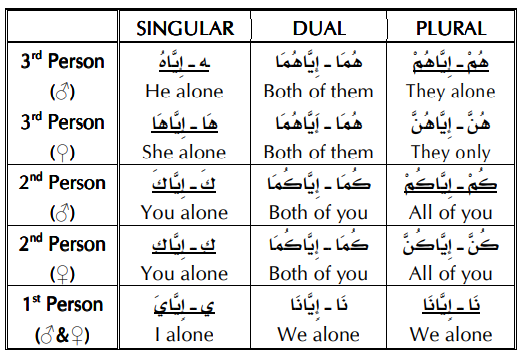
The word ( أيًا ) is prefixed to the Attached Pronouns. The word ( أيًا ) confines the meaning to ‘only/alone  ( إِيَّاكَ نَعْبُدُ وَإِيَّاكَ نَسْتَعِينُ  ) You (Alone) we worship, and You (Alone) we ask for help”[1/4]. For usage of Possessive Pronouns with ( أيًا ) see this Table:

Possessive Pronouns1

Note:

Concentrate on the underlined forms only in the beginning, and skip over the remaining forms as these are not frequently used in the Holy Quran.

All Courses

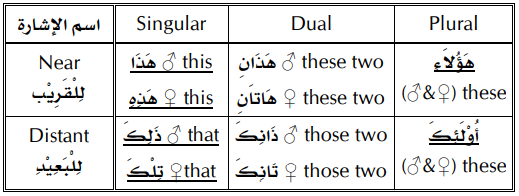
Demonstrative Pronouns (أسم الاشارة)

The demonstrative pronouns are listed below:

Demonstrative Pronouns

Note:

Concentrate on the underlined forms.

The Relative Pronouns ( ألاسم الموصول )

The relative pronouns (الذى – الذين ) etc. are used as conjunction, meaning ‘that, which, who, whom’. They serve the purpose of joining nouns/pronouns or verbs to other nouns or verbs. They have a definite form  Like:

The-Relative-Pronouns

Examples:

  • الولد الذى خرج من المسجد طالب The boy who went out of the Mosque is a student.
  • الرجال الذى خرجوا من المسجد مدرسون The men who left the office are teachers.
  •  البنت التى خرجت من البيت طالبة ‘The girl who left the house is a student.
  • هُوَ اللَّهُ الَّذِي لَا إِلَٰهَ إِلَّا هُوَ “He is Allah, beside Whom la Ilaha illa Howa (none has the right to be worshipped but He)”. [59/293]

Interrogative Pronouns ( أسماء الاستفهام )

These are given below:

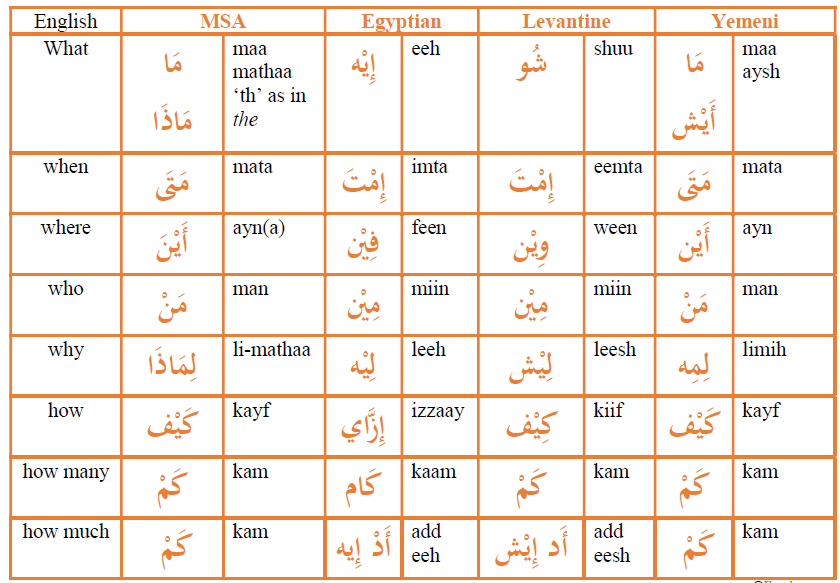
-(من ) Who (ما) What (أين) Where (كيف) How (متى ) When (كم)How Much (لماذا) For What(ماذا)  What (أنَى) Which (لم) Why

learn quran free

Get Trial Class

Learn Arabic Course – Arabic pronouns part 1

Arabic-pronouns-part-1

Arabic pronouns part 1 الضمائر

The Arabic pronoun is a word used in place of a noun, (هو) he (هى) she (هم)they (أنت) you (نحن) we (ها) her (ك) your (ى) My –  etc ……

They are of two kinds:

The Detached Pronouns, called (ضمائر منفصلة) هو – he like هو طالب he is a student.

The Attached Pronouns, called (ضمائر متصلة)  ه – his like  طالبة his student.

All Courses

The Detached Personal Pronouns (ضمائر منفصلة)

Detached Personal1

Detached Personal 2

Note:

Concentrate on the underlined forms only in the beginning, and skip over the remaining forms as these are not frequently used in the Holy Quran.

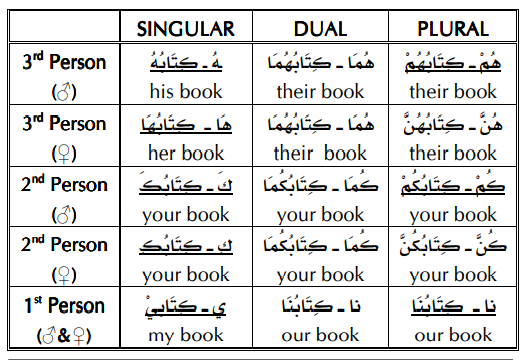
The Attached Pronouns to a noun with Possessive Relations  (ضمائر متصلة)

Attached-Pronouns

Note:

Concentrate on the underlined forms only in the beginning, and skip over the remaining forms as these are not frequently used in the Holy Quran.

learn quran free

Get Trial Class

 Pronouns Attached to a Verb:

Pronouns attached to a verb become its Direct Object, (ضرب) means ‘he struck’, ‘he’ is a subject and ‘struck’ is a verb; with the addition of an attached pronoun (هـ) ‘him’ would become the object of the verb (ضرب)  Like:

 Pronouns Attached to a Verb as its Direct Object 

Pronouns Attached to a Verb

Note:

Concentrate on the underlined forms only in the beginning, and skip over the remaining forms as these are not frequently used in the Holy Quran.

Other examples:

  • يدى my hand الكتاب فى يدى the book is in my hand.
  • يداى my two hands يداى لى المكتب  my two hands are on the table.
  • بين يدى literally between my hands in front of me الشجرة بين يدى  the tree is in front of me (على) on me or my responsibility  حسابه على ‘his account is on me.
  • لديهم with them/by them الكتاب لديهم the books are with them.
  • لى to me or for me لى عملى my action is for me’ i.e. I am responsible for my action.
  • لك ‘to you or for your ولكم عملك and your action is for you’ i.e. you are responsible for your action.
  • له to him, for him له الملك وله الحمد  to Him (Allah) belongs the universe and for Him is all the Praise.

It is followed on part 2 here:

Learn Arabic Course – THE NUMBER OF NOUNS

THE NUMBER OF NOUNS

THE NUMBER OF NOUNS  عدد ألاسماء

Unlike English, Arabic has three numbers: singular is termed wahid  (واحد) or Mufrad (مفرد) the dual or two of anything is termed tathniyah (تثنية) and more than two is plural called Jam (جمع). Learning useful arabic words for everyday conversations can significantly enhance your communication skills in Arabic-speaking environments. Mastering these basic words will help you navigate daily interactions more comfortably. Additionally, incorporating these phrases into your routine can make your learning process more engaging and effective.

1-Wahid  (واحد) or Mufrad (مفرد)

Examples: (الكتب) (القلم) (الساعة) (رجل) (يد) (بيت) (المسلم) (الكافر).

2-Tathniyah (تثنية)

The dual form ends in aani:(ان) Like (القلمان) (الكتابان) (رجلان) (طالبان) (أمراتان) (المسلمان) (الكافران).

3- The Plurals of Nouns and Adjectives:

In English, adjectives have no plural form. We say “good man” and “good men”. But in Arabic even adjectives have dual and plural form.

In English there are two types of plural :

  1. Sound Plural: In sound plural the word retains its original form, e.g. book – books, pen – pens.
  2. Broken Plural: The original form of the word is changed to a great extent, e.g. Man – men, woman – women.

In Arabic too, we have these two kinds of plural forms; Sound and Broken.

All Courses

Sound Plural in Arabic ( الجمع السالم )

The masculine plural of nouns are formed by adding (ون) to the singular form (مسلم – مسلمون) (مومن – مومنون) ( سارق – سارقون) (جاهل – جاهلون)

The feminine plural of nouns which end in (ة) are formed by changing (ة) to (ات),  As (مسلمة – مسلمات) (كافرة – كافرات) (ساعة – ساعات) (مدرسة – مدراسات) (كلمة – كلمات) 

The plural of nouns which do not end in (ة) are also formed by adding (ات) to singular  as (مريم – مريمات) (سماء – سموات).

The Broken Plural (جمع التكسير )

Unlike English, the broken plural is very widely used in Arabic. It is formed from the singular by the addition or elision of consonants, As ( رجل – رجال) (رسول – رسل)

There are many patterns of the broken plural. The following are commonly used patterns:

NUMBER OF NOUNS

learn quran free

Get Trial Class

Learn Arabic Course – THE GENDER OF NOUNS

THE-GENDER-OF-NOUNS

THE GENDER OF NOUNS   الجنس

This lesson explains the different categories of gender used for Arabic nouns. According to the Arabic grammar the
gender is classified into the following four categories:

1-Real Gender: ( الجنس الحقيقى ).

The words related to the male sex are (مذكر) masculine, and those related to the female sex are (مونث) female :

Example: (رجل) ‘man’ is a real masculine and (أمراة) ‘woman’ is a real feminine, (ولد) Boy  (بنت) Girl (أب) Father (أم) Mother.

Formal Gender (الجنس المجازى)

The nouns which do not have the ‘concept of pair’ are termed as feminine or masculine by form (الجنس المجازى) The identification of gender for such noun is that the words ending with ‘round-ta’ ( ة مربوطة ) are generally feminine, and those ending with some other letter are assumed as masculine gender.

Feminine gender by form. (مروحة ) Fan (شجرة ) Tree (سيارة ) Car (ساعة) Watch.

Masculine gender by form (كتاب) Book (بيت)  House (مسجد) Mosque(قلم) Pen.

It may also be understood that feminine gender is often formed from the masculine by suffixing ( ة ) Like (مسلم) Muslim (مسلمة) Muslim (كافر) disbeliever (كافرة) disbeliever (صادق)Truthful (صادقة) Truthful (طالب ) Student (طالبة) Student.

Exceptional Cases (الجنس اللفظى)

  1.  The nouns which do not fall under the above mentioned two categories are termed as exceptional cases.The following nouns are feminine by usage even though they have no ( ة ) (ta) ending nor have they ‘pair concept’. Like:(سماء ) Sky (نار)  Fair (شمس) Sun (حرب) War (أرض) Earth.
  2.  Proper names of countries and towns are feminine by signification  Like (مصر) Egypt (باكستان) Pakistan (أمريكا) America.
  3. Many parts of the body, especially those that are in pair, are termed as feminine, (عين)Eye  (يد) Hand.
  4. The nouns ending in ( ى ) Called (ألالف المقصورة) short Alif (اء) called (ألالف الممدودة)  (lengthened Alif) are also feminine: (حسنى) good, beautiful (كبرى) Great (صحراء) Desert (بيضاء) White.
  5. All Arabic letters of alphabet are considered as feminine.
  6. Some broken plurals, (اليهود) the Jews (الرسل) the messengers’ (النصارى) ’ the Christians’ are treated as feminine.
  7. Some collective nouns (قوم )People (رهط) tribe(أهل ) are used as feminine.

The best Quran teachers

Get Trial Class

Exceptional Masculine:

Some nouns have ta (ة) ending but they are used as masculine Like (خليفة) caliph (علامة) learned’ (أسامة) male name And some parties body LIKE (رأس) Head (صدر) chest , are used as masculine .

Common Gender (أسم الجنس)

Some nouns are used as masculine as well as feminine. These are termed as (أسم الجنس) Like (سحاب) clouds (بقر)Cow (ذهب) Gold (نحل) Bees (شجر) Tree .


Learn Arabic Course – infinitive – Verbal Noun

infinative

The Verbal Noun ( المصدر ) – infinitive

The verbal noun or noun of action may also be used as (أسم) Like (نصر) ‘help’ (literally helping) or (ضرب)a blow’ (literally striking), or (عبادة)‘prayer’ (literally praying).

The Arabic definite article (ال)

(ال) ‘al) corresponds to the English definite article ‘the’. The Arabic indefinite article Tanwin is dropped when the definite article ‘al’ is prefixed to a noun;

Examples:

(بيت) (baitun) ‘a house’ becomes (البيت) al baitu ‘the house’.

(جمل) (jamalun) ‘a camel’ to (الجمل) (aljamalu) ‘the ‘camel’.

All Courses

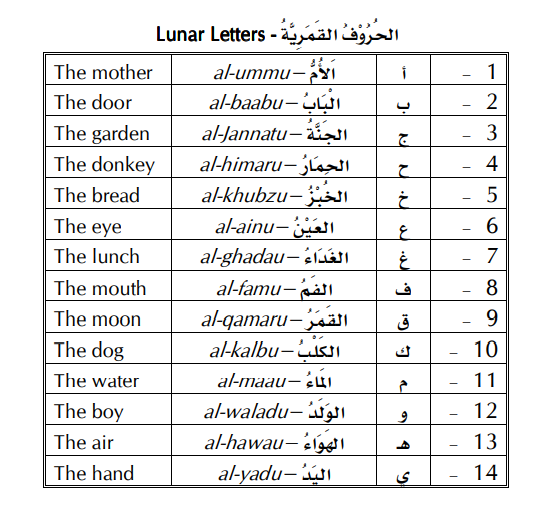
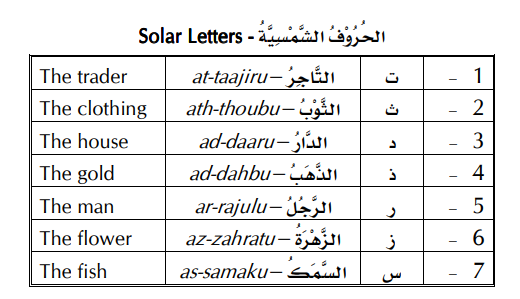
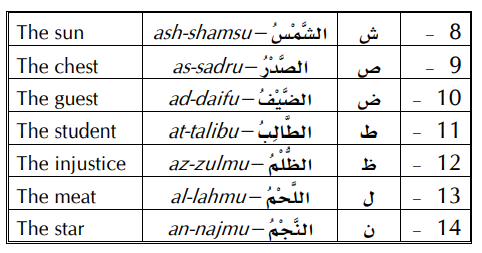
Arabic has 28 alphabets or letters; of these, 14 are called the Sun Letters (الحروف الشمسية) and the other 14 are called the Moon Letters (الحروف القمرية) In the moon letters the lam ( ال) of al is pronounced like (القمر) al-qamaru’). While in the sun letters the lam of al is assimilated to the first letter of the noun like (الشمس) ) ash-shamsu). The
assimilation is indicated by () on the first litter of the noun. A table showing the moon letters and the sun
letters is given below.

Qumarria - Letters

Shamsse Litters

Shimssia-letters22

learn quran free

Get Trial Class

Learn Arabic Course-Vowels-Harkaat

Vowels

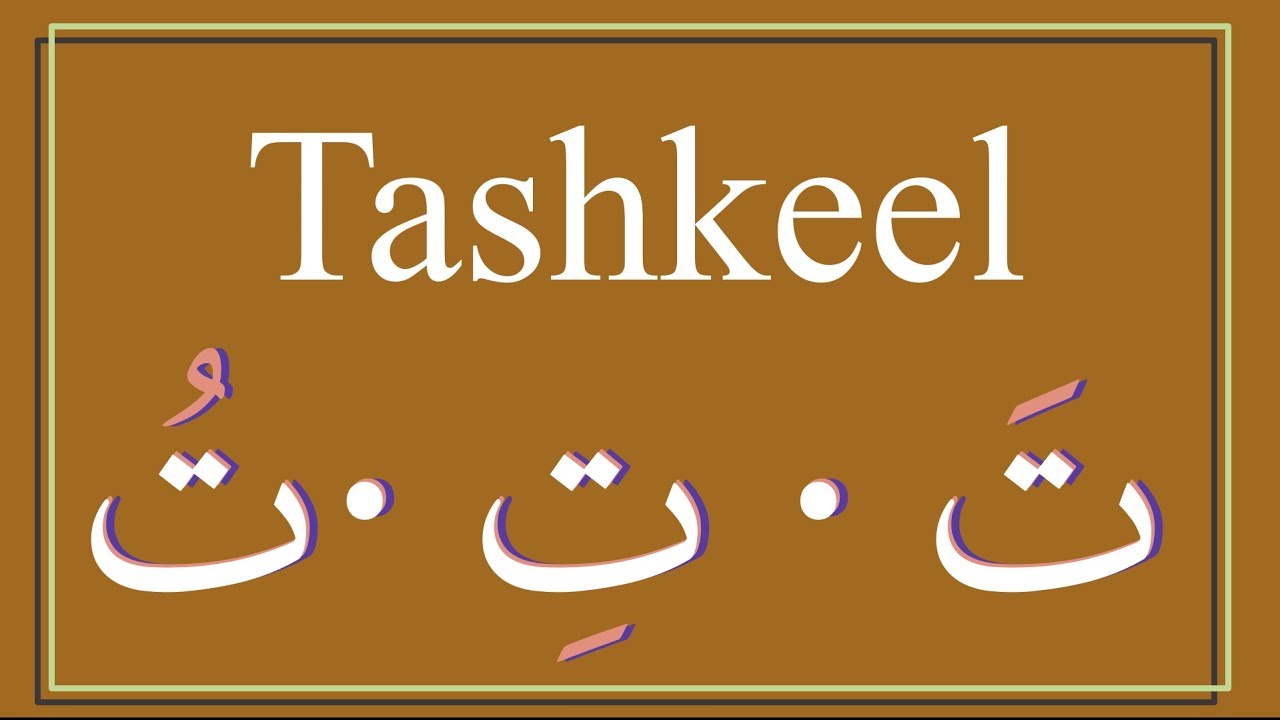
Vowels (الحركات –Harkaat)

The vowels used in Arabic are called (الحركات) which are explained below:

    • الفتحة – (Fathah): Signed as(  ـَ ) on top of a letter and pronounced as ‘a’ in ‘above’.
    • الكسرة – (Kasrah): Signed  as ( ـِ ) under a letter and pronounced as ‘i’ in ‘if’.
    • الضمة  – (Dammah): Signed as ( ـُ ) on top of a letter and pronounced as ‘u’ in “put”.
    • Harakaat

All Courses

  • سكون – ) Sukun): Signed as ( ـْ ) on top of a letter as ‘stop’ or ‘stress’; it indicates that the consonant is vowel less.
  • تنوين – ( Double vowels ) ‘N’ sound :Signed as double vowel ( ـًٌ – , ٍ– , )as indicated is called Tanween
  1.   Double fatHa: tanwiin with fatHa creates the “an” sound, as in ‘ahlan wa sahlan (ahel-an wah sahel-an; Hi). example : كتاباً (kitaban)
  2. -Double damma: tanwiin with damma creates the “oun” sound. For example, kouratoun (koo-rah-toon; ball) contains a double damma. كتابُ kitabin)
  3. -Double kasra: tanwiin with kasra makes the “een” sound, as in SafHatin (sahf-hah-teen; page)   كتابِ ( kitabin).
  4. Vowels (harakaat)

Remember that a word with Tanwin is always a noun (أســـم) also a word having (al) ( ال ) in the beginning is an indication of its being a noun, however, it does not necessarily.

mean that a word without ‘al’ or Tanwin will not bea noun (أســـم) This is evident from the examples of nouns mentioned above where certain words have neither Tanwin nor ‘al’, yet they are nouns.

It should be noted that the Tanwin and ‘al’ never come together on a noun. If ‘al’ comes in the beginning of a noun then its case-ending will be single vowel, not Tanwin, e.g.. it may be كتب (a book) or ْالكتب (the book). It is incorrect to say : الكتب

learn quran free

Get Trial Class

Learn Arabic Course (PARTS OF SPEECH )

PARTS-OF-SPEECH

PARTS OF SPEECH (أقسام الكلام)

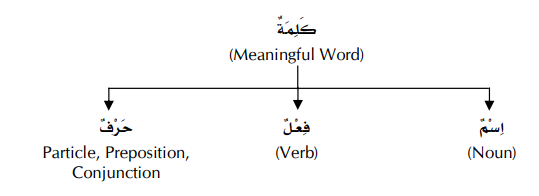
We start the Arabic lessons from the very beginning. A meaningful word in Arabic is called Kalimah (كـــلمــــة ). It has only three parts. In other words there are only three parts of speech in Arabic. These are:

  1. Noun ( أٍســــم )
  2. Verb ( فـــعـــل )
  3. Harf (حـــرف)

Noun ( أٍســــم ): literally :name.

Like :‘Muhammad’ (محمد) – Ahmad ( أحمد ) – France ( فرنسا ) – boy (ولد) – Maryam ( مريم )

It is that word which does not need the help of another word to explain its meaning. It is the name of a person, a place or a thing, and the term Ism includes the adjective nouns ( الصفة ) as well.

Verb ( فـــعـــل ):

It is that word by which we understand some work or action being done. It is of three kinds/tenses:

  1. The perfect tense, the Madi (الماضى) is used for an action which is completed,(فعل) he did (كتب) he wrote (دخل) he entered’.
  2.  The imperfect tenses the Madari (المضارع) used when an action is not completed ( يفعل ) he does or he is doing or he will do ( يكتب ) he writes/is writing/ will write( يدخل ) he enters/is entering/will enter’.
  3.  The imperative tense or the Amr ( الامر ) which
    signifies command, request or supplication( أفعل )
    ( أكتب ) ‘write ( أدخل ) ‘enter’.

Learn Arabic with Arabic Teachers

Harf (حـــرف)

The particle, preposition and conjunction are called harf. It is that word which is used with noun or verb to complete the meaning of the sentence; its meaning will depend on the word with which it is used, على ‘on’,
فى  ‘in’, ان ‘regarding’,نعم ‘yes’ لا  ‘no’ ‘ما that/ what’, etc.

Arabic-speech1

Further explanation and information about the Ism, the Fail and the Harf will follow in the subsequent lessons.

learn quran free

Get Trial Class

Most Common Arabic words & phrases

Most Common Arabic words & phrases

Arabic is the language of the Qur’an (the Islamic holy book). It doesn’t matter what your beliefs are, the Qur’an is unequivocally, undeniably and undoubtedly the greatest form of Arabic literature, and indeed the greatest form of literature, period.

Some Basic Vocabulary

General Conversation

Arabic                 Pronunciation                      Meaning

السلام عليكم               as-salaam alaeikum            peace be with you (formal greeting)

كيفِ حالك؟                 keifa haaluk                          how are things? (formal) 

ازيك                         e-zayyak                                 what’s up? (informal)

الحمد لله                   al-hamdu lillah                    praise God (formal answer)

أنا بخير                    ana bi kheir                            I’m good (formal answer)

تمام – كله تمام           tamaam / Kullu tamaam         everything’s good (informal answer)

كويس                      q-wayyis                                    fine / pretty good (informal answer)

شوِأخبارِ العمل؟          shoo akhbaar al-amal          how’s work? (informal)

السلام عليكم              as-salaam alaeikum             peace be with you (formal goodbye)

مع السلامة                ma’as-salaama                       bye (literally: with safety) (semi-formal) 

بعدين                       ba’dein                                      later (see you later) (informal)

فيما بعد                     fee maa ba’d                           after/in a while (informal) 

من اين انت                min ayna anta                        where are you from?  (formal)

أنت من فين /وين        anta min fein/wein              where are you from? (informal)

ما الساعة                   mas-saa’a                              what time is it? (formal)

كم الساعة                   as-saa’at kam                      what time is it? (informal)

Quranmyway

Travelling

Arabic                 Pronunciation                  Meaning

ِمطار                        mataar                                 airport

طيارة                        tayyaara                            airplane

ِوصول                      wusool                                arrival

مغادرة                      mughaadara                   departure

الجمارك                    al-majaarik                     customs

متاع                         mataa’                              luggage

جواز سفر                 jawaaz as-safar             passport

تاشيرة                     ta’sheera                          visa

تذكرة                       tazkira                              flight ticket 

فندق                        funduq                              hotel

ِاستقبال                    istiqbaal                            reception

مفتاح                       miftaah                             key

غرفة                       ghurfa                                room

صراف                     sarraaf                              currency exchange

learn quran free

Start Free Trial

Arabic Vocabulary

Asking Questions

Arabic                 Pronunciation                  Meaning

ما …؟                      maa                                      what is …?

من …؟                    man                                      who is …?

أين …؟                  ayna                                       where is …?

متى …؟                 mataa                                    when is …?

كم …؟                   kam                                        how much is …?

كم هذا .؟                kam haaza                            how much is this? 

كيف …؟                keifa                                       how… ?

لماذا ..؟                 li maaza                                why ?

الساعة المحلية         as-saa’al mahalliya          the current time

At about 1,500 years old, Arabic also happens to be a very old language. It was the language of scholarship throughout the rule of the Islamic empires – a period of well over 1,000 years from the 7th century right down to the 19th and even 20th.


Put any question in comment
Our Blog
Our Courses

Arabic Numbers & Counting

Arabic Numbers & Counting

One could be interested to understand that, although you’ll need to learn a replacement set of Arabic numerals, you really already know a group of Arabic numerals. the foremost wide spread numbering system within the world, the (0, 1, 2, 3, 4, 5, 6, 7, 8, 9) that was adapted by Europe and therefore the Western world within the 12th century AD, is really an Arabic numbering system.

Arabic-numbers


Book Free Trial & Start your journey of Quran, Arabic, and Islam e-Learning today

Quran Courses


Numeral       Transcription        Pronunciation         Meaning

صفر                                 ٠                         Sifr                                       0

واحد                                  ١                        waahid                                1

اثنان                                  ٢                        ithnaan / ithnein            2

ثلاثة                                  ٣                        thalaatha                           3

أربعة                                  ٤                        arba’a                                 4

خمسة                                 ٥                       khamsa                               5

ستة                                   ٦                       sitta                                      6

سبعة                                  ٧                       sab’a                                     7

ثمانية                                 ٨                       thamaania                         8

تسعة                                  ٩                       tis’a                                      9

عشرة                               ١٠                      ashara                                 10

أحد عشر                               ١١                   ahada ashar                     11

أثنى عشر                              ١٢                   ithna ashar                       12

ثلاثة عشر                             ١٣                   thalaatha ashar              13

أربعة عشر                             ١٤                  arba’a ashar                    14

عشرة                               ١٠                      ashara                                 10

عشرين                             ٢٠                      ishreen                               20

ثلاثين                              ٣٠                       thalaatheen                       30

أربعين                             ٤٠                       arba’een                              40      

خمسين                              ٥٠                     khamseen                          50    

ستين                             ٦٠                        sitteen                                  60

سبعين                              ٧٠                      sab’een                                70

ثمانين                              ٨٠                      thamaaneen                      80

تسعين                              ٩٠                      tis’een                                  90

مائة                              ١٠٠                       mi-a                                    100                 
learn quran free

Start Free Trial

  • It comes from the Arabic numeral system, which has three families of numerals. the primary family consists of the Hindu numerals, which are utilized in India.
  • The second family, the West Arabic numerals, were adapted by the western world and are now used for many international commerce.
  • Lastly, there are the Eastern Arabic Numerals, which are used predominantly within the Arabic speaking world and what you’ll learn below.

Arabic-numbers

arabic-numbers-counting


Put any question in comment
Our Blog
Our Courses

50 Arabic words with English translation

50 Arabic words with English translation

-These are list of 50 Arabic words with English translation , More than 50 Arabic Nouns  and Words  with English translation.

Words ———-> Arabic   ———->  Pronunciation

  1. water                       مـــــــاء                                     ma’a
  2. pants                         بنطال                                      binital
  3. father                         الاب                                      alab
  4. boy                             صبى                                      sibi
  5. beef                        لحم بقرى                                   lahm biqar
  6. shirt                         قميص                                     qamis
  7. nurse                     ممرضة                                     mumarada
  8. friend                      صديق                                     sadiq
  9. son                             ابن                                       abn
  10. ice                              جليد                                      jalid
  11. girl                             فتاة                                      fata
  12. week                        اسبوع                                   usbue
  13. Browse courses    Book Free trial
  14. fish                            سمكة                                   smak
  15. sofa                             كنبة                                   kanba
  16. snow                           ثلج                                    thalaj
  17. today                         اليوم                                   alyawm
  18. bathroom              صديق                                    hamam
  19. adult                         بالغ                                     baligh
  20. hour                         ساعة                                   saea
  21. man                         رجل                                      rajul
  22. bed                         السرير                                    alsarir
  23. cloud                        غيم                                     ghym
  24. woman                 النساء                                     alnisa
  25. chicken                 دجاج                                      dijaj
  26. shoe                        حذاء                                    hidha
  27. hotel                     الفندق                                    alfunduq
  28. year                         عام                                     eam
  29. beer                        بيرة                                     bayra
  30. boyfriend            حبيب                                    habib
  31. doctor                   طبيب                                   tabib
  32. tea                          شاى                                    shay
  33. mother                    ام                                     um
  34. computer          الحاسب                                   alhasub
  35. tomorrow            غدا                                     ghadaan
  36. girlfriend           صديق                                    sadiqa
  37. pork                لحم خنزير                                   lahm khinzir

    Book Free Trial & Start your journey of Quran, Arabic, and Islam e-Learning today

  38. sock                     جراب                                     jurib
  39. kitchen                مطبخ                                   mutabikh
  40. coffee                    قهوة                                   qahua
  41. teacher               مدرس                                   mudaris
  42. daughter               ابنة                                   aibnatu
  43. minute                 دقيقة                                   daqiqa
  44. rain                        مطر                                   tumtir
  45. head                      راس                                   rayiys
  46. yesterday       فى الامس                                  fi al’ams
  47. second                  ثانية                                   thaniaan
  48. wife                      زوجة                                   zawja
  49. TV                         تلفاز                                    talfaz
  50. child                      طفل                                   tifl

📚 Did you find this article helpful? This is just the beginning.

Imagine having a qualified teacher to guide you, answer your specific questions, and provide a structured path to mastering the Quran.

  • At QuranMyWay Academy, we move beyond articles to offer:
  • Live, Interactive Classes with certified teachers.
  • Personalized Learning Plans tailored to your age and level.
  • A Supportive Community of fellow students on the same journey.
  • Direct Feedback on your recitation and understanding.
  • Don’t just read about Islam; live it and understand it deeply.
The best Quran teachers

Put any question in comment
Our Blog
Our Courses

Most Used Arabic Words & phrases

Most Used Arabic Words & phrases

-These are list of beautiful Arabic words , More than 25 Arabic words and phrases with English translation.

phrases ———-> Arabic   ———->  Pronunciation

like you                                 أنا أحبك                                ana ‘ahbik

I love you                                  أحبك                                 ahbak

You are cute                      أنت اللطيف                              ant latif

You are beautiful              أنت جميل                              ant jamila

You are handsome            أنت وسيم                               ant wasim

You’re a great person         أنت شخص عظيم             ant shakhs eazim

Can I see you again?      يمكن ان اراك مرة اخرة           ymkn ‘an ‘arak maratan ‘ukhraa؟

Let’s meet again              دعنا نتقابل مرة اخرى             daeuna natqabl maratan ‘ukhraa

Love                                        حــــــب                                    hubun

Beautiful                               جـــميل                                     jamila

Pretty                                     جـــميل                                      jamila

Cute                                         جذاب                                     jadhdhab

learn quran free

Start Free Trial

Attractive                            ملفت للانتباه                              mulifat lilaintibah

Handsome                              وسيم                                   wasim

Nice smile                           أبتسامة لطيفة                            aibtisamat latifa

Nice eyes                                عيون جميلة                            euyun jamila

Nice                                            لطيــف                                 latif

Let’s go somewhere           هيا نذهب لمكان ما                     hayaa nadhhab ‘iilaa makan maa.

Let’s go on a date.                    لنتواعد                             linatawaed.

Can I have your number?   هل بامكانى الحصول على رقمك    hal bi’iimkani alhusul ealaa rqmk?

You look great                         تبدوا رائع                             tabdu rayieaan

great                                                عظيم                               eazim

You look nice                        أنت تبدو لطيف                           ant tabdu latifa

I like your shoes                   يعجبنى حذاءك                          aejibni hadhawuk

I like your jacket                  يعجبنى سترتك                           uhibu satirtak

I like your dress                   يعجبنى فستانك                            yaejabuni fustank


Put any question in comment
Our Blog
Our Courses

list of beautiful Arabic words

list of beautiful Arabic words

-These are List of Arabic words with English translation, list of beautiful Arabic words You can use it in greetings and more ..

All Courses

let’s start:

30-Greetings ——-> Arabic ——->  Pronunciation

hello                                                  مرحبا                                  marhabaan

hi                                                        مرحبا                                  marhabaan

good morning                             صباح الخير                              sabah alkhyr

good afternoon                          مساء  الخير                              masa’ alkhayr

good evening                               مساء الخير                              masa’ alkhayr

good day                                           يوم جيد                               good day 

hey                                                         مهلا                                mahlaan

how are you?                                  كيف حالك                             kayf halikm?

how is everything?               كيف تجرى الامور                          kayf tajri alamwr?

what’s up?                                         ماذا تفعل                            madha tafiel?

long time no see                     وقت طويل لروياك                          waqt tawil la ruya

excuse me                                             عفوا                               efu

hello, my name is..                 مرحبا , أسمى هو                         marhabaan aismi..

bye                                                              وداعا                           wadaeaan

good bye                                                    وداعا                           wadaeaan

see you later                                          اراك لاحقا                       arak lahiqaan

see you tomorrow                                  اراك غدا                      arak ghadaan

let’s meet again                      دعنا نتقابل مرة اخرى                     daeuna natqabl maratan ‘ukhraa

have a good day                           اتمنى لك يوم جيدا                    atamanaa lak yawm jayid

have a good night                        أتمنى لك ليلة هنيآ                    atamanaa lak laylat hania

learn quran free

Get Trial Class

good night                                         تصبح على خير                    tusbih ealaa khayr

How is your day?                                  كيف يومك                     kayf yawmk?

What’s new?                                            ما الجديد                      ma hu aljadiyd?

How’s life?                                             كيف الحياة                     kayf alhayaata?

Nice to see you                              من الجميل ان اراك                  min aljamil ‘ana ‘arak

Nice to meet you                             تشرفت بمقابلتك                   tasharafat bimuqabalatik

How have you been?                       كيف كان حالك                    kayf kan halak?

Hello everyone                                   تحياتى للجميع                   tahiat liljamie

How are you feeling?                           كيف تشعر                    kayf tasher ?

I have to go                                        يجب الان أن أذهب                 yjb ealaa ‘ana ‘adhhab


Put any question in comment
Our Blog
Our Courses

4 tips on how to learn Arabic successfully part2

4 tips on how to learn arabic successfully part2

You should read part -1

Starting from reading is actually way easier. Then, starting from listening, we want to start from the reading and then build our way up all the way to listening. Listening is our goal, really.
I mean, I want to get to the point where I’m listening to the imam, recite the Quran and I can just make total sense of it until the day comes to an end. And I’m engaged with the words of Allah, that’s a final skill that’s like when you’ve reached your goal, kind of in in your study of Arabic. That’s a pretty major milestone. It’s not the highest milestone. What’s a pretty major milestone when you can stand in prayer and understand even one phrase or to phrase, you start picking things up. That’s pretty cool.

We can start getting there soon, but eventually you want to get to the point where anything you recite, maybe one or two words you’re missing, and then you could look those up. Or you can ask the person who led the prayer here. What did you mean by what word is that what stood out was that from? And you can find that out and build that, Okay, in any case. So I’ve started with four skills once again because I want you to remember the stuff we started with the output skills writing and speaking. And we eliminated those for the purpose of Quran study. Then we talked about listening and reading and be eliminated.
We’re gonna focus.

1-The first one :

You’re going to read the Quran and try to make sense of what you are reading. And that’s cool. That’s actually a pretty easy way to narrow down your focus. Okay, so that’s the first one before most part of the discussion today that I wanted to get out of the way. Don’t worry about what? Stop stressing yourself out about vocabulary. It will come. I promise you it will come and you’ll be very good at it. And actually, the vocabulary of the Quran is easier than most of the vocabulary of Arabic.

You can’t just have the you know which book should I study. Books are just, uh, information. It’s what method will I use to teach that book right? The method has to be right for a student to be able to really retain their stuff, so it’s not just about getting a book and going through it, and you’ll get it.

2-The second thing is:

clear objectives. Now that we’re worried Onley about reading, let’s get clear about our objectives if you are someone and I’m only gonna talk about three groups today, right? And then we’re gonna be done with this session First group.

learn quran free

Start Free Trial

To be clear .

If you’re somebody who knows absolutely zero about the Arabic language, you know nothing about the alphabet you know nothing about. You know, the pronunciation. You’re absolutely zero. Okay, you know nothing. Or you’re someone who used to know. And now you for gotten okay. Now you don’t remember what it was or you You read it so poorly, you’re almost embarrassed to read it in front of somebody else, right? Or even to yourself out loud. You feel hesitation in doing that then And many of you if that If that’s the beginning level you’re at. It’s gonna be hard for you to go to a mush it and sit down with a bunch of like, 11 year olds and they’re reading better than you are. And you’re saying that embarrassing yourself, it’s gonna be hard, right ?

You could maybe take a college course.

College courses are pretty expensive on. Also, when you go to a college course, they’re not going to say we’re just gonna focus on reading. They’re gonna say, reading, writing, speaking, listening. There you go again. I’m focused on four skills where I needed to focus on one. That’s another problem. You could try to do this on your own on. That’s gonna be a challenge, and sometimes you try to do it with a tutor online. Many of you have tutors online, and for some of you it’s a hit or a miss. Sometimes you make it.

Sometimes you don’t, and sometimes they’re pretty good. Ah, lot of times there because they’re foreigners themselves. They wanna take you on a pace that they’re used to, or that they’re used to teaching kids and kids don’t learn the same way as adults. Kids are sponges. They can pick things up quickly. But you’re 35 years old. You’re 27 years old. You’re not gonna be able to pick up quickly as Children.

And now you start feeling inadequate and you get de motivated. I take you back to the first challenge. If you’re not motivated, you’re not gonna learn.


See All Course.
Visit Our Website


4 tips on how to learn arabic successfully part1

4 tips on how to learn Arabic successfully part-1

Introduction

This session to I’m gonna talk to you about, you know, we’re zoning in on studying the Arabic for the purpose of understanding that we’re on. And just so everybody again has a heads up,I do want you to remember some of these things that I’m sharing with you. This is not relevant. Maybe for everybody but those of you that are interested in learning Arabic to help. You understand the Koran. I think you’ll find this discussion beneficial. Okay, so when it comes to learning any language, you wanna be able to acquire four skills, Okay? There any language that you’re good at you you wanna be able to say I have four skills in that language.

Those skills are:

Reading, writing, listening and speaking. I’ll say that again. Reading, writing, listening and speaking. And the way to organize those skills. Like when you go to like, I used to study Spanish in high school, and, I’m trying to learn some Turkish now, at one point or another. I’ve tried to learn several other different languages.

For example:

The listening When you go to a language class, your professor, your teacher will get you to say something speaking, I’ll get you to say my name is this or here’s how you say hello or here’s how you say Welcome. Here’s how you say Good evening, etcetera, etcetera. Right, that’s speaking.

They’ll try to introduce you to the alphabet of that language that’s writing. Obviously they’ll say something and expect that you understand what they said.

The reading They’ll put words on the board or in your textbook, and they’ll expect you to read it in that language the way it’s supposed to be pronounced. I want you to take those four skills reading, writing, speaking and listening and restructure them.
learn quran free

Start Free Trial

For that

Reorganize them in your mind again. We’re learning not Spanish or German or French. Actually, we’re not even learning Arabic for a general purpose. We’re learning Arabic to understand the Quran. It’s a very specific purpose. Are entire study of the language is focused primarily first on a book and then everything else in that language.

4 tips on how to learn Arabic successfully

In beginning, The speaking becomes less important. And writing becomes less important. Because for the average Muslim who just wants to understand the Quran , they’re not going to sit there and right, so little because they’re gonna read it, they’re not gonna write it. And even if they never learned how to write it properly, it wouldn’t make a difference. They’re not interested in writing.

So writing is not a top priority. If you’re studying Arabic for the purpose of the Quran especially those of you that are trying to study this part time, you have limited time to study anyway. And you want to make the most of every minute of effort you’re gonna put in too. Learn why would you spend time learning and and prioritizing something that won’t take you to your immediate goal ?

So writing is basically you put an X on it. In the beginning, there’s we’re not gonna focus on writing the same thing about speaking. I mean, okay, you know now how to say that it’s the weather is nice today or it’s sunny today.

So what ?

How is that gonna help you understand when the Imam reciting the prayer or when you’re reciting the Koran? So you’re speaking skills are about you producing language. You producing words on you expressing yourself. It’s not about understanding the Koran. So as an early skill set, even though in a normal Arabic classroom, these air or any foreign language classroom, these are like top priority skills, you start with these. Like if you don’t have this, what do you have that kind of thing? You know? And even if your friends say, Hey, Rahman Rahim .

So we come back to that. I mentioned four skills at the top of this session. I’ve reduced it now to to skills. It’s two skills are gone. Writing is gone for now, and speaking has gone for now. So what’s left. What’s left is reading and listening.

What’s left is reading and listening. Now, even within reading and listening will prioritize. By the way, focusing on two skills is way easier than focusing on four skills, isn’t it ?

For example.

if I’m listening to Arabic, I’m trying to process that information that it goes through my ears and my brains, trying to make sense of what’s being said the same way. If I’m reading, my eyes are taking these words and they’re making. I’m trying to make sense of it in my head. That’s input. But when you’re speaking or writing its output, you’re producing stuff.

So for the purposes of understanding the text of the Quran , the sacred text. We’re focused on input. We’re focused primarily on input now within input. One of them is a lot harder than the other. Uh, listening is way harder than reading.

It will be continue here part 2

See All Course.
Visit Our Website