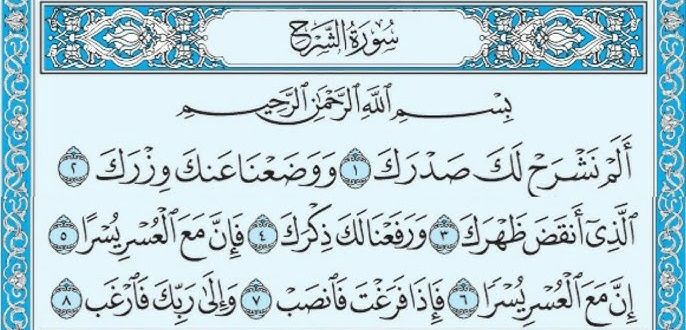
Learn Surah Ash-Sharh Tajweed Rules

Ash-Sharh

Read Surah Ash-Sharh

Explanation of Surah Ash-Sharh :

نَشْرَحْ : Hams and Rakhawa in (ش) – Means running of sound of Shi’n (ش) with running Air together .

صَدْرَكَ :Qalqalah in (د) , There are five Qalqalah Letters ( ق – ط- ب- -ج – د )

وَوَضَعْنَا : Take are of Makhrij of (ض) – From one of the edge of tongue or both of edge with Isti’tallah ( This Makhrij is very tall , Takes All Edge of tongue ) don’t forget tafkhem in (ض)

عَنكَ : Ikhfa’a Haqeqe means hide Noon Into Ka’f (ك) , more details remove Makhrij of Noon pronounce Ghounnah in (ك).

ٱلَّذِىٓ أَنقَضَ : Alif Maad Munfasel four or five Vowel counts (Haraqahs).

أَنقَضَ : Ikhfa’a Haqeqe , Don’t forget Tafkheem of Ghunnah.

Understanding the nuances of the ‘Ikhfa’a Haqeqe‘ letters is crucial for beautiful recitation. In our structured Tajweed course, we break down each letter with live examples and personalized feedback from qualified instructors. Ready to perfect your recitation? Explore our Tajweed courses here:

Browse courses    Book Free trial

Explanation:

ظَهْرَكَ : Tafkheem of (ظَ) and Hams and Rakhawa in (هــ) – Means running of sound of Shi’n (هــ) with running Air together .

وِزْرَكَ – ذِكْرَكَ  :

1-Hams and Rakhawa in (زْ)

2- Hams (كَ) in both words Means running of Air and Shaddah as well – Shaddeh Means stop running of letter sound .

إِنَّ – فَإِنَّ : Noon with Shaddah On (نَّ) vowel 2 Haraqahs and make Ghunnah as well.

ٱلْعُسْرِ يُسْرًا  : Hams and Rakhawa in (سْ)

فَإِذَا : The (ذَ) The tip of tongue is out of mouth little bit like (Th) in English – There Letters in Arabic should Pronounced like that      ث – ظ- ذ

فَٱنصَبْ : It is IKhfaa Haqeqe For  Noon Sakinah (ن) with (صَ) – In Ikhfaa Noon Sakinah or Tanween are not pronounced Makhraj , only Gunnah is pronounced , There are 15 letters for Ikhfaa and صَ one of these letters, .

فَٱرْغَب : When stop on (ب) Make it Sakinah therefore Qalqalah (Echo ) should be applied  – the quick movement of the tongue or lips upon articulation.

Understanding the nuances of the ‘Surah Ash-Sharh‘ is crucial for beautiful recitation. In our structured Tajweed course, we break down each letter with live examples and personalized feedback from qualified instructors. Ready to perfect your recitation? Explore our Tajweed courses here:

Book Free Trial & Start your journey of Quran, Arabic, and Islam e-Learning today


Surah Ash-Sharh Translation ( Tafseer ) :

أَلَمۡ نَشۡرَحۡ لَكَ صَدۡرَكَ 

Did We not expand for you, [O Muhammad], your breast?

 وَوَضَعۡنَا عَنكَ وِزۡرَكَ  

 And We removed from you your burden.

ٱلَّذِيٓ أَنقَضَ ظَهۡرَكَ  

Which had weighed upon your back.

وَرَفَعۡنَا لَكَ ذِكۡرَكَ 

And raised high for you your repute.

 فَإِنَّ مَعَ ٱلۡعُسۡرِ يُسۡرًا  

For indeed, with hardship [will be] ease.

إِنَّ مَعَ ٱلۡعُسۡرِ يُسۡرٗا 

Indeed, with hardship [will be] ease.

 فَإِذَا فَرَغۡتَ فَٱنصَبۡ 

So when you have finished [your duties], then stand up [for worship].

 وَإِلَىٰ رَبِّكَ فَٱرۡغَب 

And to your Lord direct [your] longing.
Learn Surah At-Tin with Tajweed Rules

Learn Surah At Tin with Tajweed Rules

Learn Surah Al Tin with Tajweed Rules

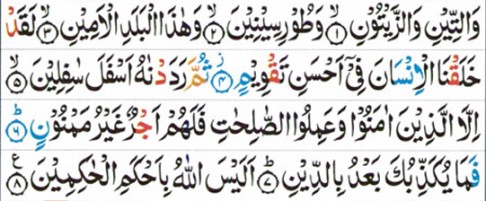
Explanation Of Surah At-Tin :

وَٱلتِّينِ : Tha Ta’a has Shaddah on it , try to push the Makhraj of (ت) – that means Press on letter.

ٱلْأَمِينِ – سِينِينَ – وَٱلزَّيْتُونِ :  Stopping on these words stop by Sukoon on (ى) Or The (و) letter is Al-Madd Al-‘Aarid Lil Sukoon (Presented Sukoon ) : The reciter must stop after the word being recited in order to sound this madd 2,  4 or 6 counts.

وَطُورِ : it is Tafkheem Letter , fill of your mouth by the ط Letter – There are seven Tafkheem Letters ( خ – ض – ض- غ  ط  ق – ظ )

وَهَـٰذَا : The (ذَ)  The tip of tongue is out of mouth little bit like (Th) in English – There Letters in Arabic should Pronounced like that      ث – ظ- ذ

لَقَدْ – خَلَقْنَا : In Both of (دۡ) (ق) Qalqalah Rules , I mentioned about this rules above many times.

ٱلْإِنسَـٰنَ : IKhfaa Haqeqe For  Noon Sakinah ( Tanween with Fatiha )  with  س  ,  In Ikhfaa Noon Sakinah or Tanween not pronounced Makhraj , only Gunnah is promounced.

فِىٓ أَحْسَنِ : In Ya’a Maad Munfasel four or five Vowel counts (Haraqahs).

Browse courses    Book Free trial

The best Quran teachers

Explanation:

ثُمَّ : Meem Mushddad With Ghunnah length it two vowels counts.

رَدَدْنَـٰهُ : Qalqalah in (د) , There are five Qalqalah Letters ( ق – ط- ب- -ج – د ) .

ٱلَّذِينَ-  ءَامَنُوا۟ : Ya’a and Waw is Madd Tabiyyie ( 2 Harakahs ).

أَجْرٌ : letter ( ج ) is one of Qalqla lettters , There are 5 Qalqla lettters (ق – ط – ب-ج – د )

أَجْرٌ غَيْرُ : Ithaar Halqe because Tanween is followed by ( غ ) – It means to pronoun Tanween Clearly in Tajweed six Ithaar Halqe Letters ( ء – ه -ع – ح -غ – خ ) .

Book Free Trial & Start your journey of Quran, Arabic, and Islam e-Learning today

يُكَذِّبُكَ : The (ذَ)  The tip of tongue is out of mouth little bit like (Th) in English – There Letters in Arabic should Pronounced like that      ث – ظ- ذ

بِأَحْكَمِ : Make sure you do correct Kassrah , Lesson to slow Recitation

ٱلْحَـٰكِمِينَ :  Small Alif Madd Tabiyyie ( 2 Harakahs ) And Ya’a Madd Al-‘Aarid Lil Sukoon (Presented Sukoon )

Surah At-Tin Translation ( Tafseer ) 

وَٱلتِّينِ وَٱلزَّيۡتُونِ 

By the fig and the olive, that is, the two [edible] foods — or [these denote the names of] two mountains in Syria on which these two foods grow.

 وَطُورِ سِينِينَ 

And [by] the Mount Sinai, the mountain on which God, exalted be He, spoke to Moses (sīnīn means ‘the one blessed’ or ‘the fair one with fruitful trees’).

 وَهَٰذَا ٱلۡبَلَدِ ٱلۡأَمِينِ 

And [by] this secure land: Mecca, as people were secure in it in the time of pagandom and [are still secure in it] in Islam.

لَقَدۡ خَلَقۡنَا ٱلۡإِنسَٰنَ فِيٓ أَحۡسَنِ تَقۡوِيمٖ 

Verily We created man (al-insān: the generic) in the best of forms, [in the best] proportioning of his shape.

 ثُمَّ رَدَدۡنَٰهُ أَسۡفَلَ سَٰفِلِينَ  

Then, in the case of certain individuals of his [species], We reduced him to the lowest of the low — a metaphor for old age and weakness, at which point a believer’s deeds are fewer .

إِلَّا ٱلَّذِينَ ءَامَنُواْ وَعَمِلُواْ ٱلصَّٰلِحَٰتِ فَلَهُمۡ أَجۡرٌ غَيۡرُ مَمۡنُونٖ 

Except those who believe and perform righteous deeds, for they shall have an unfailing reward, one unending — in a hadīth [it is stated], ‘When a believer reaches that stage of old age which prevents him from performing [good] deeds.

 فَمَا يُكَذِّبُكَ بَعۡدُ بِٱلدِّينِ  

So what makes you deny, O disbeliever, thereafter — after the mention of man being created in the best of forms and his being reduced to the vilest of age, all of which indicates the power [of God] to resurrect — the Judgement?, the Requital that will be preceded by the Resurrection and the Reckoning.

أَلَيۡسَ ٱللَّهُ بِأَحۡكَمِ ٱلۡحَٰكِمِينَ 

Is not God the fairest of all judges?, the most just of all judges. His passing judgement by means of [the process of] requital is one such example. In a hadīth.

Things You Need to Know About The Quran – Part 3

Things You Need to Know About The Quran - Part 3

Why was the Quran revealed in stages rather than all at once?

he Qur’an was revealed in stages over a period of approximately 23 years rather than as a complete book at once for several divine and practical reasons:
  • To Strengthen the Prophet’s Heart: Continuous revelation allowed Allah to address the Prophet Muhammad directly and repeatedly whenever the need arose, providing ongoing support throughout his mission.
  • Consideration for the Prophet: The process of receiving revelation was described as a “very difficult experience” for the Prophet. Receiving the entire text at once would have been an immense physical and spiritual burden.
  • Ease of Memorization and Application: A gradual revelation made it much easier for the early believers to understand, memorize, and apply the verses in their daily lives. Since the community was largely unlettered, learning the Quran in smaller portions was essential for its preservation in their hearts.
  • Gradual Implementation of Laws: The staged revelation allowed for the gradual implementation of Islamic laws, giving the community time to adjust to new social and legal prescriptions. A primary example provided in the sources is the prohibition of wine, which was introduced through three separate verses revealed at different times to allow for a transition.
  • Flexibility and Abrogation: Because some verses were abrogated (replaced) during the course of the Prophet’s lifetime, revealing the text in stages maintained the necessary flexibility for the evolving needs of the new Muslim community.
  • Responding to Circumstances: Many revelations were “situation-oriented,” appearing in response to specific events, questions from the community, or challenges faced by the Prophet. These “reasons for revelation” (asbab al-nuzul) helped clarify the intent and application of the verses within their original context.

Which Surahs are considered the ‘mufassal’ section of the Quran?

The mufassal section of the Qur’an is the final portion of the scripture, beginning with Sura Qaf (Sura 50) and extending through to the end of the book at Sura 114.
Scholars categorize the chapters of the Qur’an into four types based on their length, and the mufassal is identified as the last section. A notable characteristic of this group is that the majority of the suras within it are of Makkan origin. Additionally, the 30th juz’ (part) of the Qur’an, which begins with Sura 78, is located within this Mufassal sectino.

Are there non-Arabic words in the Quran?

While the Qur’an describes itself as being in “pure and clear” Arabic, there is a difference of opinion among scholars regarding whether it contains words of non-Arabic origin.
The discussion generally falls into two perspectives:
  • Integrated Vocabulary: Some scholars, such as Tabari and Baqillani, argue that everything in the Qur’an is Arabic . They maintain that while certain words may have had non-Arabic origins, they were genuinely integrated into the Arabic language through use and observation by the Arabs long before the revelation.
  • Foreign Origins: Other scholars believe the Qur’an does contain specific words derived from other languages. Examples cited in the sources include:
    • al-Qistas (17:35), derived from Greek.
    • al-Sijjil (15:74), derived from Persian.
    • al-Ghassaq (78:25), derived from Turkish.
    • al-Tur (2:63), derived from Syriac.
    • al-Kifl (57:28), derived from Abyssinian.

Quran memorization advices online
Learn Surah Al Baiyyainh with Tajweed Rules

Additionally, it is widely conceded that there are non-Arabic proper names throughout the text, such as Isra’il, Imran, and Nuh. The scholar Suyuti even compiled a work listing 118 expressions found in the Qur’an that originate from various different languages.
Ultimately, the revelation was sent in Arabic so that it would be understood by its first audience the people of Makka and because the messenger himself was an Arab .

What is the meaning of the ‘abbreviated letters’?

The “abbreviated letters,” known in Arabic as Al Muqatta’at, refer to certain letters found at the beginning of 29 Surahs of the Quran. The term is derived from the root ‘qata’a’, meaning “what is cut” or “what is abbreviated”.
These letters are considered an important section of the mutashabihat (the “unclear” or allegorical verses) because their exact meanings are not known. While their ultimate meaning is known only to Allah, they are a fundamental part of the Qur’anic message and are recited as part of the chapters where they occur.
Occurrence and Distribution
There are fourteen such letters that appear in various combinations. Some examples of their occurrence include:
  • Alif Lam Mim: Found at the beginning of six suras (2, 3, 29, 30, 31, 32).
  • Ha Mim: Found at the beginning of seven suras (40–46).
  • Alif Lam Ra: Found at the beginning of five suras (10, 11, 12, 14, 15.
  • Other combinations include Ta Ha, Ya Sin, Sad, Qaf, and Nun.

The best Quran teachers

Variety of Explanations:

Since the purpose and meaning of these letters are uncertain, Muslim scholars have offered a variety of interpretations throughout history:
  • Abbreviations: They may be abbreviations for specific sentences or words; for instance, Alif Lam Mim might mean Ana llahu A’lam (“I am Allah, the All-Knowing”), or Nun might stand for Nur (“Light”).
  • Divine Symbols: Some view them as symbols or names of Allah.
  • Numerical Value: They may hold numerical significance, similar to how Semitic letters often have associated numerical values.
The sources also note that some non-Muslim orientalists have suggested they might be abbreviations for the names of the scribes who wrote for the Prophet or symbols to distinguish suras before they were given common names, though these scholars generally conclude that the letters remain mysterious and have “baffled interpretation”. Regardless of the interpretation, the Qur’an refers to them as “symbols of the perspicuous book”.

Things You Need to Know About The Quran – Part 2

Things You Need to Know About The Quran - Part 2

What are the key differences between the Makkan and Madinan phases?

The growth and development of the Muslim community are marked by two distinct phases: the Makkan phase, which lasted about 13 years before the hijra, and the Madinan phase, which lasted about 10 years until the Prophet’s death. According to the sources, the key differences between these phases involve their primary themes, the groups addressed, and the length and style of the revelations.

1. Primary Themes and Focus

  • Makkan Phase: The primary task of the Prophet during this period was to call people to Islam Consequently, the revelations focused on Tawhid (the unity of Allah), the coming resurrection and judgment, and righteous conduct. The Prophet’s role was primarily that of an announcer and warner.
  • Madinan Phase: While the basic Makkan themes remained, the focus shifted toward the formation of the umma (community). Revelations in this phase introduced social and legal implications, such as laws concerning marriage, divorce, inheritance, and punishment. It also addressed matters like warfare, which only began after the hijra.

Browse courses    Book Free trial

2. Audience and Forms of Address

  • Makkan Revelations: These often address “O Mankind” or “O People”. They frequently include stories of earlier prophets and their struggles to provide guidance and reminders.
  • Madinan Revelations: These more frequently address the believers as “O ye who believe” or address the “People of the Book” (Jews and Christians). This reflects the new social environment in Madina, which included the muhajirun (migrants), the ansar (helpers), and the ahl al-kitab.

The best Quran teachers

3. Length and Literary Style

  • Length: Makkan verses and suras are generally short, whereas Madinan ones are typically longer. For example, the 30th juz’, which is overwhelmingly Makkan, contains 543 verses, while a single Madinan surah like Al-Anfal (Sura 8) has only 75 verses but covers more physical space in the text.
  • Specific Markers:
    • Makkan: All suras containing the word kalla or verses of sajda (prostration) are Makkan. Most suras in the mufassal section (the latter part of the Qur’an) are also from the Makkan period.
    • Madinan: All references to the hypocrites (munafiqun) are of Madinan origin (with one minor exception).

4. Importance of the Distinction

Understanding these differences is crucial for interpreting legal rulings. Knowing the chronology helps scholars determine which rulings are currently binding through the science of abrogation (al-nasikh wa al-mansukh), as many Islamic practices—such as the prohibition of alcohol or the rules regarding fighting—were developed gradually over these two phases. Generally, a sura is classified based on where its beginning was revealed, even if it contains verses from the other period.

How did the Angel Gabriel review the text with Muhammad?

The Angel Gabriel reviewed the Qur’an with Prophet Muhammad primarily through annual recitations during the month of Ramadan .
According to the sources, the review process followed these key patterns:
Frequency of Review: Gabriel used to recite the entire Quranwith the Prophet once every year.
However, in the final year of the Prophet’s life, Gabriel reviewed and recited the text with him twice.

Connection to I’tikaf: This review often coincided with the Prophet’s period of i’tikaf (seclusion in the mosque). While he usually stayed in i’tikaf for ten days each year, he extended this to twenty days in the year of his death, during which the double review took place.

Finalizing the Arrangement: The purpose of these reviews, particularly the final ones, was to determine the final order and arrangement of the verses (Ayat) and the chapters (Surahs).

Things You Need to Know About The Quran – Part 1
The Last Verse Of The-Quran
Learn Surah Al-qadr With Tajweed Rules

This ensured that the structure of the revelation was fixed according to divine guidance before the Prophet’s passing.

Exact Transmission: During these sessions, Gabriel brought the exact wording and contents to the Prophet, who was instructed to follow the recital precisely .
The Prophet would then announce and dictate the revelation to his scribes in the same manner he received it from Gabriel .
These measures served as a divine verification process to ensure the text was preserved and organized exactly as Allah intended .

What are the earliest surviving manuscripts of the Quran?

Most of the early original Qur’an manuscripts, whether complete or in sizeable fragments, date from the second century after the Hijra. However, there are several notable surviving examples and fragments that date back even earlier to the first century:
  • First-Century Fragments: There are a number of odd fragments of Qur’anic papyri available that date from the first century Hijra.
  • Egyptian National Library Manuscript: This is a copy on parchment made from gazelle skin which has been dated to 68 Hijra (688 A.D.), roughly 58 years after the Prophet’s death.
  • The Samarkand Manuscript: Currently kept in Tashkent (Uzbekistan), this manuscript is believed to be one of the original copies prepared during the time of Caliph ‘Uthman or the “Imam” manuscript he kept for himself. Evidence for its extreme age includes its use of gazelle parchment and the absence of diacritical marks and vowelling symbols, which were not introduced until later in the first century.
  • The ‘Ali Manuscript: Located in the Dar al-Kutub al-‘Alawiya in Najaf, Iraq, this manuscript is written in Kufi script and contains a signature stating it was written by ‘Ali bin Abi Talib in the year 40 Hijra.
  • The Cairo Manuscript: Kept in the mosque of al-Hussain in Cairo, this old script version is considered a possible copy of the original Mushaf of ‘Uthman.
  • The Madina Manuscript: Historically, a manuscript was kept in the mosque of Madina until 1915, when it was moved by Turkish authorities; it eventually reached Istanbu.
The earliest copy exhibited in the British Museum during the 1976 World of Islam Festival was dated to the late second century. While ‘Uthman originally sent five official copies to cities like Makka, Damascus, Kufa, Basra, and Madina, historical accounts from the third century onwards indicate that some were destroyed in fires or wars, though various travelers reported seeing sheets or copies of them in cities like Granada and Marakesh over the centuries . 

Things You Need to Know About The Quran – Part 1

Things You Need to Know About The Quran - Part 1

How was the Qur’an preserved and compiled into a book?

The preservation and compilation of the Qur’an was a meticulous process that occurred in stages, beginning during the lifetime of Prophet Muhammad and concluding with a standardized written volume during the reign of the third Caliph, ‘Uthman. This process relied on two primary methods: oral transmission (memorization) and written documentation.

1. Preservation During the Prophet’s Lifetime (610–632 AD)

The Qur’an was revealed in stages over 23 years, rather than as a complete book at once. During this time, it was preserved through:
  • Memorization: The Prophet was the first to memorize the revelations brought by the Angel Gabriel. He encouraged his Companions to do the same, and many committed the entire text to memory. Reciting the Qur’an in daily prayers further solidified this oral preservation.
  • Initial Writing: Although the Prophet himself was unlettered, he appointed scribes, such as Zaid bin Thabit, to write down revelations as they were received.
  • Arrangement: The Prophet provided specific instructions on the order of the verses (Ayat) and chapters (Suras).
  • Status at Death: At the time of the Prophet’s death, the entire revelation existed in the memories of many Companions and was written on various materials like leather, shoulder blades, and palm stalks, but it had not yet been gathered into a single volume.

Browse courses    Book Free trial

2. The First Collection under Abu Bakr (632–634 AD)

Following the Battle of Yamama, where many qurra (memorizers) were killed, ‘Umar bin al-Khattab feared that parts of the Qur’an might be lost. He persuaded Caliph Abu Bakr to formally collect the text.
  • The Task of Zaid bin Thabit: Abu Bakr appointed Zaid bin Thabit to lead the effort. Zaid collected the material from both the written records and the memories of men.
  • The Suhuf: This effort resulted in the Suhuf, a collection of loose sheets containing the entire Qur’an with the internal order of verses fixed. These sheets were kept by Abu Bakr, then ‘Umar, and eventually passed to Hafsa, the daughter of ‘Umar and a widow of the Prophet.

Book Free Trial & Start your journey of Quran, Arabic, and Islam e-Learning today

3. The Standardization under ‘Uthman (644–656 AD)

As the Muslim empire expanded, differences in the recitation of the Qur’an began to emerge due to various Arabic dialect. To prevent confusion and dispute, Caliph ‘Uthman took action:
  • The Mushaf: ‘Uthman borrowed the original Suhuf from Hafsa and ordered a committee, again led by Zaid bin Thabit, to produce several perfect copies.
  • Universal Standard: These copies were written in the dialect of the Quraish, the tongue in which the Qur’an was originally revealed.
  • Distribution: ‘Uthman sent these official copies to major centers of the Muslim world (such as Makka, Damascus, Kufa, and Basra) and ordered all other fragmentary or unofficial materials to be destroyed to ensure a single, unified text. This version is known as the Mushaf ‘Uthman and represents the consensus of the Prophet’s Companions.

Things You Need to Know About The Quran – Part 2
Best Online Quran Academy in 2025
Quran And Tajweed Definition

4. Later Enhancements to the Script

While the text of the Qur’an remained unchanged from the ‘Uthmanic version, the script evolved to assist readers, especially non-Arabs:
  • Tashkil (Vowelling): Marks were introduced to indicate vowels and ensure correct pronunciation.
  • I’jam (Diacritical Marks): Points were added to distinguish between letters that had the same basic shape (e.g., ba, ta, and tha)
According to the sources, these measures ensured that the Quran remained protected by Allah against any corruption and that its text and arrangement have remained identical to this day

The best Quran teachers

Tell me about the scribes who wrote for the Prophet ?

Although the Prophet Muhammad was unlettered and did not write down the revelation himself, he ensured its preservation by appointing scribes to document the verses as they were revealed.
The Role and Process of the Scribes
  • Dictation: When the Prophet received a revelation, he would call for a scribe and dictate the words exactly as they were given to him.
  • Materials: Scribes were instructed to bring specific tools for the task, such as a board, an ink pot, and a scapula bone (the shoulder blade of an animal). Other materials used for recording included bits of leather and palm stalks.
  • Arrangement: The Prophet did not just dictate the words; he provided specific instructions on the internal order of the text. He would tell the scribe exactly which sura (chapter) a newly revealed aya (verse) belonged in and where it should be placed.

Notable Scribes and Figures

  • Zaid bin Thabit: He was one of the most prominent scribes in Madina and was frequently called upon by the Prophet to record the “Divine Inspiration”. His expertise led him to play a central role in the later formal collection of the Qur’an under Caliphs Abu Bakr and ‘Uthman.
  • Number of Scribes: While Zaid was a primary figure, he was part of a larger group. The sources mention that there were approximately 48 persons who used to write for the Prophet.
  • Waraqa bin Nawfal: Though not a scribe for the Prophet’s revelations, he is mentioned as a person who could write in Arabic and had written portions of the Gospel in Arabic prior to the Prophet’s mission.

Promotion of Literacy

The Prophet actively encouraged the skill of writing among his community. For example, following the Battle of Badr, he allowed certain prisoners of war to gain their freedom on the condition that they taught ten Muslims how to write. This emphasis on literacy supported the wider effort to maintain a written record of the revelation alongside oral memorization.

How did the Prophet ensure the correct arrangement of verses?

The Prophet Muhammad ensured the correct arrangement of the Qur’an through direct instruction to his scribes and regular verification with the Angel Gabriel. Although the Qur’an was revealed in stages over 23 years and not always in its final chronological order, its internal arrangement was fixed by the Prophet during his lifetime.
The Prophet’s methods for ensuring this order included:
  • Specific Dictation to Scribes: Whenever a revelation was received, the Prophet would call for a scribe, such as Zaid bin Thabit, and provide precise instructions on where the new verses should be placed. He would explicitly state, “Place these Ayat in the sura, in which this and this is mentioned,” ensuring the internal order of the chapters was documented immediately.
  • Divine Review with Gabriel: The Angel Gabriel played a crucial role in finalizing the arrangement. Gabriel used to recite the Qur’an with the Prophet once every year during the month of Ramadan. In the final year of the Prophet’s life, this review occurred twice, which served to determine the final order and arrangement of both the verses (Ayat) and the chapters (Suras).
  • Communal Reinforcement: This established order was not kept secret; it was well known to the Companions and strictly observed by them. The arrangement was reinforced through the Prophet’s public recitations during daily prayers, allowing the community to memorize the verses in their correct positions.
  • Safeguarding through Oral and Written Means: By the time of the Prophet’s death, the entire revelation was available in both memorized form and on various writing materials, with the internal order of the verses already fixed and safeguarded.
Because of these measures, the arrangement of the Quran is considered to have remained identical to the order determined by the Prophet himself .

📚 Did you find this article helpful? This is just the beginning.

Imagine having a qualified teacher to guide you, answer your specific questions, and provide a structured path to mastering the Quran.

  • At QuranMyWay Academy, we move beyond articles to offer:
  • Live, Interactive Classes with certified teachers.
  • Personalized Learning Plans tailored to your age and level.
  • A Supportive Community of fellow students on the same journey.
  • Direct Feedback on your recitation and understanding.
  • Don’t just read about Islam; live it and understand it deeply.

Arabic numbers for beginners

Arabic numbers for beginners

Arabic Numbers for Beginners: A Complete Guide (1 to 100+)

How to write the numbers themselves. In most of the Arab world, they don’t use 1, 2, 3 as we do in the West. They use their own numerals: ٠, ١, ٢, ٣, ٤, ٥, ٦, ٧, ٨, ٩.

The Words: How to say the numbers. For example, the word for “one” is واحد (Wahid), and “two” is اثنان (Ithnan).

Arabic Numbers Table:

0                       Sifir                                        30                       Tlateen
1                       Wahid                                    40                       Ara’been
2                       Itnaym                                   50                       Khamseen
3                       Talaata                                   60                       Sitten
4                       Arb’a                                     70                        Sebeen
5                       Khamsa                                 80                        Tamannen
6                       Sitta                                      90                         Tiseen
7                       Sab’a                                    100                        Miyya
8                       Tamanya                              101                        Miyya wa-wahid
9                       Tes’a                                     150                        Miyya Khamseen
10                     Ashra                                   200                        Mitayn
11                     E-Daish                                500                        Khamsa Miyya
12                    Tnish                                    1000                       Alf
13                    Tletaish                                2000                      Alfayn
14                    Arb’ataish                           3000                       Talaat Alaaf
15                    Khamistaish                       100000                    Meet Alaaf
20                    Ashreen                              Million                    Millyoun
1/2                  Nous                                  1/4                            Robah

Book Free Trial & Start your journey of Quran, Arabic, and Islam e-Learning today

Quran Courses

Learn Arabic Numbers: A Step-by-Step Guide for Beginners

At first glance, Arabic numbers might look intimidating. The squiggles and curves seem completely foreign to an English speaker. But here is the secret that changes everything: the numbers you already use every day (1, 2, 3) are actually Arabic numerals.

That’s right. The numeral system we call “Arabic” in the West (1, 2, 3) originated in North Africa. Meanwhile, in the Middle East, they use a different set of symbols (١, ٢, ٣).

The good news? Both systems are easy to learn if you take it step by step. Let’s begin.

Step 1: The Two Systems – Don’t Get Confused

Before you learn a single number, you need to know which “version” of Arabic numbers you are learning.

  • Western Arabic Numerals (What you already know): 1, 2, 3, 4, 5… (Used in most math and Western contexts).

  • Eastern Arabic Numerals (Used in the Arab world): ١, ٢, ٣, ٤, ٥…

For this guide, we will focus on the Eastern Arabic numerals used in newspapers, street signs, and markets in countries like Egypt, Saudi Arabia, and the UAE.

Value Eastern Arabic Western Arabic
0 ٠ 0
1 ١ 1
2 ٢ 2
3 ٣ 3

Step 2: Master the Digits 0 to 9

Your first goal is to connect the symbol to the sound. Practice writing these while saying the Arabic word out loud.

  • 0 – صفر (Sifr) – From this word, we get the English word “zero” and “cipher.”

  • 1 – واحد (Waaḥid)

  • 2 – اثنان (Ithnān)

  • 3 – ثلاثة (Thalātha)

  • 4 – أربعة (Arbaʿa)

  • 5 – خمسة (Khamsa)

  • 6 – ستة (Sitta)

  • 7 – سبعة (Sabʿa)

  • 8 – ثمانية (Thamāniya)

  • 9 – تسعة (Tisʿa)

Pro Tip: The letter ʿ represents a “guttural stop” – a sound not found in English. Think of the catch in your throat when you say “uh-oh.”

Book Free Trial & Start your journey of Quran, Arabic, and Islam e-Learning today

Quran Courses

Step 3: Count from 10 to 99 (The Easy Pattern)

Here is where Arabic becomes logical. Numbers 10-19 are unique, but once you hit 20, it’s a simple formula: Tens + and + Ones.

The Teens (11-19)

To say 15, you say “five-ten” (khamsa-ta’ashar). Notice the word for ten changes slightly.

  • 10 – عشرة (ʿAshara)

  • 11 – أحد عشر (Aḥad ʿashar)

  • 12 – اثنا عشر (Ithnā ʿashar)

  • 13 – ثلاثة عشر (Thalāthat ʿashar)

  • 20 – عشرون (ʿIshrūn)

The 20s, 30s, and beyond (20-99)

Learn the tens, then simply add the unit.

The Tens:

  • 20 – عشرون (ʿIshrūn)

  • 30 – ثلاثون (Thalāthūn)

  • 40 – أربعون (Arbaʿūn)

  • 50 – خمسون (Khamsūn)

  • 60 – ستون (Sittūn)

  • 70 – سبعون (Sabʿūn)

  • 80 – ثمانون (Thamānūn)

  • 90 – تسعون (Tisʿūn)

To build a number: Say the ten, then the word wa (and), then the unit.

  • 25 = 20 + 5 = ʿIshrūn wa khamsa (عشرون و خمسة)

  • 47 = 40 + 7 = Arbaʿūn wa sabʿa (أربعون و سبعة)

  • 82 = 80 + 2 = Thamānūn wa ithnān (ثمانون و اثنان)

Step 4: The “Gender Flip” Rule (The Tricky Part)

This is where beginners usually give up, but don’t worry. Here is the rule in plain English:

For numbers 3 to 10, the number’s gender opposes the noun’s gender.

  • Arabic nouns are either masculine or feminine.

  • The word for “car” (sayyara) is feminine. So you use the masculine form of the number.

  • The word for “book” (kitāb) is masculine. So you use the feminine form of the number.

Example:

  • Three books (masculine noun) → Thalāthatu kutub (Use feminine form: Thalāthat)

  • Three cars (feminine noun) → Thalāthu sayyarātin (Use masculine form: Thalāth)

Don’t memorize the grammar now! Just be aware it exists. For your first month, people will understand you even if you get this wrong.

Start A Free Trial

Step 5: Hundreds, Thousands, and Big Numbers

Arabic builds big numbers exactly like English, reading from largest to smallest.

Hundreds:

  • 100 – مائة (Miʾa)

  • 200 – مئتان (Miʾatān)

  • 300 – ثلاثمائة (Thalāth miʾa) – literally “three hundred”

  • 1,000 – ألف (Alf)

Read this number: 1,245
Alf wa miʾatān wa khamsa wa arbaʿūn (One thousand, two hundred, five and forty).

Notice the order is: Thousands → Hundreds → Tens → Ones.

Step 6: Practical Use (Phone Numbers & Prices)

You don’t need to be a mathematician to speak Arabic. Focus on real-life situations.

Phone Numbers: Say each digit individually, just like in English.

  • 010 234 5678 → Sifr waaḥid sifr, ithnān thalātha arbaʿa, khamsa sitta sabʿa thamāniya

Prices at a market:

  • “How much?” = Bikam?

  • “Five” (hold up 5 fingers) = Khamsa

  • “Twenty” = ʿIshrīn

Time:

  • 3:00 = Al-sāʿa al-thālitha (The third hour)

  • 7:15 = Al-sāʿa al-sābʿa wa rubʿ (The seventh hour and a quarter).

Your 7-Day Practice Plan

  • Days 1-2: Write the symbols ٠ to ٩ ten times each. Say the word aloud every time you write.

  • Day 3: Count objects in your house (pens, spoons, windows) from 1 to 20.

  • Day 4: Learn the tens (20-90). Create flashcards.

  • Day 5: Practice phone numbers from your contact list. Read them aloud in Arabic.

  • Day 6: Go to a market (or online store) and say the prices out loud.

  • Day 7: Write out your birth year (e.g., 1990) and your house number in Arabic script.

Start today: Write your own phone number in Eastern Arabic numerals. You have just taken step one.

📚 Did you find this article helpful? This is just the beginning.

Imagine having a qualified teacher to guide you, answer your specific questions, and provide a structured path to mastering the Quran.

  • At QuranMyWay Academy, we move beyond articles to offer:
  • Live, Interactive Classes with certified teachers.
  • Personalized Learning Plans tailored to your age and level.
  • A Supportive Community of fellow students on the same journey.
  • Direct Feedback on your recitation and understanding.
  • Don’t just read about Islam; live it and understand it deeply.