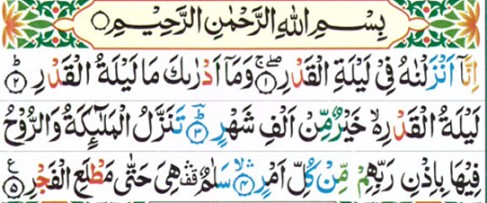
إِنَّآ : Noon Mushadad aways two Vowels counts With Ghunnah.
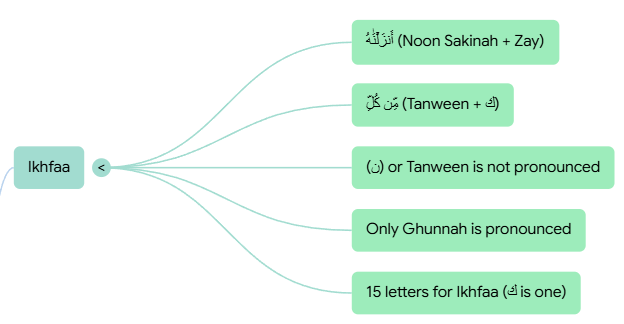
أَنزَلۡنَٰهُ: IKhfaa between Noon Sakinah ( ن ) and Zay (ز) , In Ikhfaa ( ن ) is not pronounced , only Ghunnah is pronounced .
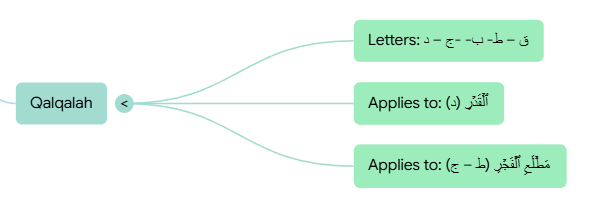
ٱلۡقَدۡرِ : Qalqalah in (د ) , There are five Qalqalah Letters ( ق – ط- ب- -ج – د ) .
وَمَآ أَدۡرَىٰكَ: Alif Madd (Madd Munfasel) length it Four or five Vowel counts (Haraqahs).
خَيۡرٞ مِّنۡ: Tanween with Dammah is followed by ( م ) Idgham with Ghunnah – Two vowels counts.
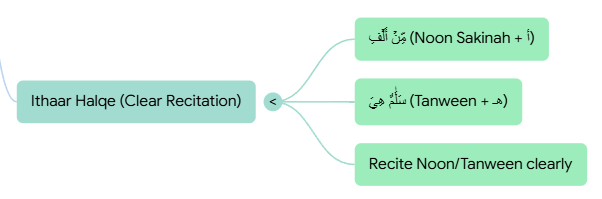
مِّنۡ أَلۡفِ: Ithaar Halqe For Noon Sakinah Followed with ( أ ) – recite Noon clear .
ٱلۡمَلَٰٓئِكَةُ : The Alif followed by Hamzah in the same word will be It’s Madd Mutasel (Connected Maad) lengths 4 or 5 vowels counts.
رَبِّهِم مِّن: Meem Sakinah Followed by Meem , The rule is Idgham Mutamasiyan Sagher With Ghunnah Two vowels counts.
مِّن كُلِّ: IKhfaa For Tanween , In Ikhfaa ( Tanween ) is not pronounced , only Ghunnah is pronounced, There are 15 letters for Ikhfaa and ك one of these letters.
سَلَٰمٌ هِيَ: Ithaar Halqe For Tanween with Dammah because Followed by (هـ) Read tanween like Noon Sakinah clearly.
مَطۡلَعِ ٱلۡفَجۡرِ: Qalqalah in (ط – ج) , There are five Qalqalah Letters ( ق – ط- ب- -ج – د ) .
1. What is the rule for Noon Mushadad, and how is it applied in the word إِنَّآ?
2. Explain the rule of Ikhfaa as demonstrated in the phrase أَنزَلۡنَٰهُ.
3. What is Qalqalah, and which five letters does this rule apply to? Provide an example from the text.
4. Describe the rule of Alif Madd (Madd Munfasel) and its specific application inوَمَآ أَدۡرَىٰكَ.
5. How is Idgham with Ghunnah applied when Tanween with Dammah is followed by the letter Meem (م), as seen in خَيۡرٞ مِّنۡ?
6. What is the rule of Ithaar Halqe, and how does it affect the recitation of Noon Sakinah in مِّنۡ أَلۡفِ?
7. What distinguishes Madd Mutasel from other types of Madd, as seen in the word ٱلۡمَلَٰٓئِكَةُ?
8. Explain the rule of Idgham Mutamasiyan Sagher and cite the example provided in the text.
9. Describe the rule of Ikhfaa when it applies to Tanween, using the phrase مِّن كُلِّ as an example.
10. What is the rule for Tanween followed by the letter Ha (هـ) in the phrase سَلَٰمٌ هِيَ?
——————————————————————————–
Answer Key
1. The rule for Noon Mushadad is that it is always held for two vowel counts with Ghunnah (a nasal sound). In the word إِنَّآ, this rule is applied to the Noon (ن).
2. In أَنزَلۡنَٰهُ, the rule of Ikhfaa occurs between the Noon Sakinah (ن) and the letter Zay (ز). When applying Ikhfaa, the Noon is not pronounced; only the Ghunnah is pronounced.
3. Qalqalah is a phonetic rule applied to five specific letters: ق, ط, ب, ج,د. An example from the text is the letter Dal (د) in ٱلۡقَدۡرِ or the letters Ta (ط) and Jeem (ج) in مَطۡلَعِ ٱلۡفَجۡرِ.
4. Alif Madd, or Madd Munfasel, is an elongation rule. Inوَمَآ أَدۡرَىٰكَ, it is applied by lengthening the sound for four or five vowel counts (Haraqahs).
5. Inخَيۡرٞ مِّنۡ, the Tanween with Dammah is followed by a Meem (م), triggering the rule of Idgham with Ghunnah. This means the sounds are merged and held for two vowel counts with a nasal sound.
6. The rule of Ithaar Halqe applies when Noon Sakinah is followed by the letter Alif/Hamzah (أ). This rule requires the Noon to be recited clearly, without any Ghunnah or merging, as in the phrase مِّنۡ أَلۡفِ.
7. Madd Mutasel (Connected Maad) occurs when an Alif is followed by a Hamzah within the same word. As seen in ٱلۡمَلَٰٓئِكَةُ, this requires the sound to be lengthened for four or five vowel counts.
8. Idgham Mutamasiyan Sagher occurs when a Meem Sakinah is followed by another Meem. As demonstrated in رَبِّهِم مِّن, this rule requires merging the two sounds with Ghunnah for two vowel counts.
9. In مِّن كُلِّ, Ikhfaa for Tanween is applied because the Tanween is followed by Kaf (ك), which is one of the 15 Ikhfaa letters. The Tanween is not pronounced; instead, only the Ghunnah is pronounced.
10. In سَلَٰمٌ هِيَ, the rule is Ithaar Halqe for Tanween because the Tanween with Dammah is followed by the letter Ha (هـ). This requires the Tanween to be read clearly, like a Noon Sakinah.
——————————————————————————–
Surah Al Qadr Translation ( Tafseer ) :
إِنَّآ أَنزَلۡنَٰهُ فِي لَيۡلَةِ ٱلۡقَدۡرِ
Lo! We revealed it, that is, the Qur’ān, in its entirety, [sending it down] from the Preserved Tablet to the
heaven of this world, on the Night of Ordainment, that is, [the Night] of great eminence.
وَمَآ أَدۡرَىٰكَ مَا لَيۡلَةُ ٱلۡقَدۡرِ
And what will show you, [what] will make known to you, O Muhammad (s), what the Night of Ordainment
is? — [intended] to emphasise its great status and to provoke marvel at it.
لَيۡلَةُ ٱلۡقَدۡرِ خَيۡرٞ مِّنۡ أَلۡفِ شَهۡرٖ
The Night of Ordainment is better than a thousand months, in which there is no Night of Ordainment, for a
righteous deed on that Night is better than one [performed] for a thousand months without it.
The angels and the Spirit, namely, Gabriel, descend in it, on that night, by the leave of their Lord, by His command, with every command, that God has decreed from that year to the following one.
سَلَٰمٌ هِيَ حَتَّىٰ مَطۡلَعِ ٱلۡفَجۡرِ
It is peaceful until the rising of the dawn , until the time it rises: it is peaceful because of the numerous salutations [of peace] (salām) spoken in it by the angels .
Mastering Surah Al Alaq recitation techniques can greatly enhance your understanding and appreciation of the Quran. By focusing on proper articulation, you can ensure that every word is conveyed accurately. Additionally, practicing regularly with a mentor can provide valuable feedback that will accelerate your learning journey. Explanation: وَيْلٌۭ لِّكُلِّ : Tanween (Two Damma ) is…
The Two Saakin Letters Meeting التقاء الساكنين In the Arabic language there is prohibition of two Saakin (non voweled) letters meeting, Except if they are present in one word and these two letters are pronounced in this case. 1-In one word . 2-Between two words . In one word 1-In case of stopping only: …
Introduction to Surah Al Ikhlas Surah Al Ikhlas, the 112th chapter of the Quran, holds immense significance in Islam and carries several benefits for those who recite it with sincerity and understanding. 1- al-Ikhlas ( MONOTHEISM ). 2-Arrange of Surah : (111) 3-Number of Ayats: (4) 4-where revealed: Makkiyah Why Was Surah Al Ikhlas Revealed (Asbab al-n-Nuzul)? A group…
Surah Yassin is one of the Makkah surahs of the Noble Qur’an, and its number of verses is (83). It is a great surah that focuses on the issue of resurrection and resurrection. Many hadiths were narrated about the Benefits of Surat Yassin, differing in their authenticity, but all of them confirm the Benefits of…
What are the key differences between the Makkan and Madinan phases? The growth and development of the Muslim community are marked by two distinct phases: the Makkan phase, which lasted about 13 years before the hijra, and the Madinan phase, which lasted about 10 years until the Prophet’s death. According to the sources, the key…
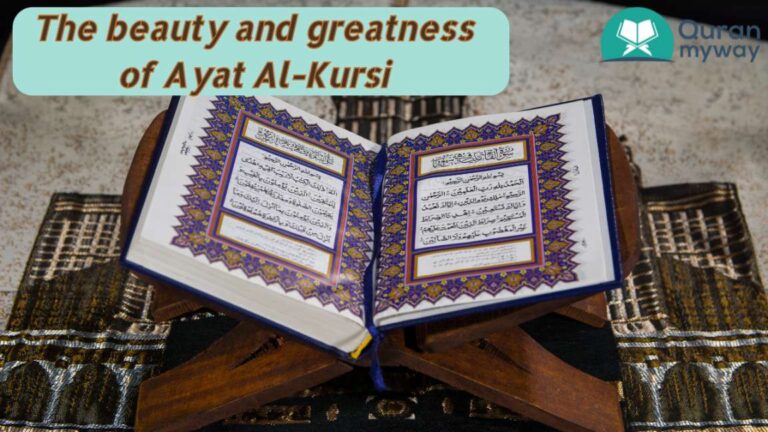
The Verse 255 of Surah Al-Baqarah, which is known as Ayat Al-Kursi in Arabic, is the greatest verse of the Quran. It enumerates qualities of Allah (SWT) and is described as one of the most significant verses in the Quran since it has been showering its people with many blessings and rewards. The Verse and…
2 Comments
Tajveed (also spelled Tajweed) is the set of rules for correctly pronouncing the words of the Qur’an. It ensures that each letter is articulated from its proper place (makhraj) with the correct characteristics, like lengthening (madd), pauses, and emphasis. The purpose of Tajveed is to preserve the original pronunciation as revealed to the Prophet Muhammad ﷺ, allowing for clear, respectful, and accurate recitation. QuranTutor.ai—developed by Meem Academia—is an AI-powered Quran learning app that delivers real-time feedback on Tajweed and pronunciation, offers interactive lessons, quizzes, and connects learners with qualified teachers for personalized guidance. With over 1.8 million users, it blends advanced technology with traditional scholarship to make Quran recitation easier, more effective, and accessible anytime, anywhere https://www.qurantutor.ai/






Tajveed (also spelled Tajweed) is the set of rules for correctly pronouncing the words of the Qur’an. It ensures that each letter is articulated from its proper place (makhraj) with the correct characteristics, like lengthening (madd), pauses, and emphasis. The purpose of Tajveed is to preserve the original pronunciation as revealed to the Prophet Muhammad ﷺ, allowing for clear, respectful, and accurate recitation. QuranTutor.ai—developed by Meem Academia—is an AI-powered Quran learning app that delivers real-time feedback on Tajweed and pronunciation, offers interactive lessons, quizzes, and connects learners with qualified teachers for personalized guidance. With over 1.8 million users, it blends advanced technology with traditional scholarship to make Quran recitation easier, more effective, and accessible anytime, anywhere https://www.qurantutor.ai/