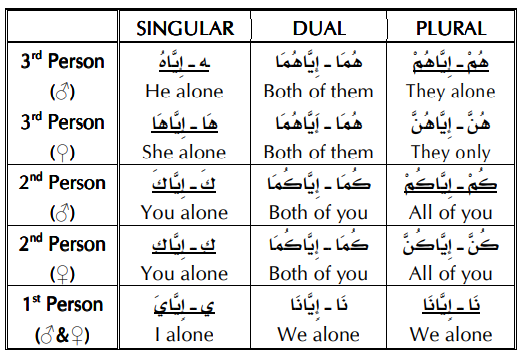
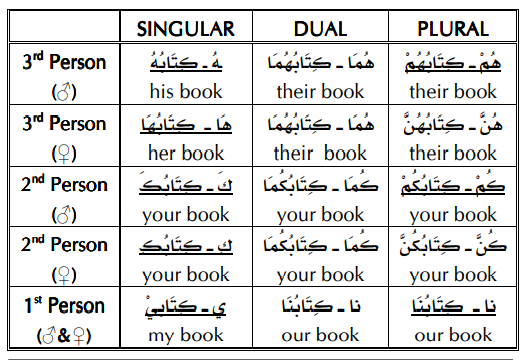
The word ( أيًا ) is prefixed to the Attached Pronouns. The word ( أيًا ) confines the meaning to ‘only/alone ( إِيَّاكَ نَعْبُدُ وَإِيَّاكَ نَسْتَعِينُ ) You (Alone) we worship, and You (Alone) we ask for help”[1/4]. For usage of Possessive Pronouns with ( أيًا ) see this Table:
Note:
Concentrate on the underlined forms only in the beginning, and skip over the remaining forms as these are not frequently used in the Holy Quran.
The relative pronouns (الذى – الذين ) etc. are used as conjunction, meaning ‘that, which, who, whom’. They serve the purpose of joining nouns/pronouns or verbs to other nouns or verbs. They have a definite form Like:
Examples:
الولد الذى خرج من المسجد طالبThe boy who went out of the Mosque is a student.
الرجال الذى خرجوا من المسجد مدرسونThe men who left the office are teachers.
البنت التى خرجت من البيت طالبة ‘The girl who left the house is a student.
هُوَ اللَّهُ الَّذِي لَا إِلَٰهَ إِلَّا هُوَ “He is Allah, beside Whom la Ilaha illa Howa (none has the right to be worshipped but He)”. [59/293]
Interrogative Pronouns ( أسماء الاستفهام )
These are given below:
-(من ) Who (ما) What (أين) Where (كيف) How (متى ) When (كم)How Much (لماذا) For What(ماذا) What (أنَى) Which (لم) Why
Pronouns attached to a verb become its Direct Object, (ضرب) means ‘he struck’, ‘he’ is a subject and ‘struck’ is a verb; with the addition of an attached pronoun (هـ) ‘him’ would become the object of the verb (ضرب) Like:
Pronouns Attached to a Verb as its Direct Object
Note:
Concentrate on the underlined forms only in the beginning, and skip over the remaining forms as these are not frequently used in the Holy Quran.
Other examples:
يدىmy hand الكتاب فى يدى the book is in my hand.
يداىmy two hands يداى لى المكتب my two hands are on the table.
بين يدىliterally between my hands in front of me الشجرة بين يدى the tree is in front of me (على) on me or my responsibility حسابه على ‘his account is on me.
لديهمwith them/by them الكتاب لديهم the books are with them.
لىto me or for me لى عملى my action is for me’ i.e. I am responsible for my action.
لك ‘to you or for your ولكم عملك and your action is for you’ i.e. you are responsible for your action.
لهto him, for him له الملك وله الحمد to Him (Allah) belongs the universe and for Him is all the Praise.
Unlike English, Arabic has three numbers: singular is termed wahid (واحد) or Mufrad (مفرد) the dual or two of anything is termed tathniyah (تثنية) and more than two is plural called Jam (جمع). Learning useful arabic words for everyday conversations can significantly enhance your communication skills in Arabic-speaking environments. Mastering these basic words will help you navigate daily interactions more comfortably. Additionally, incorporating these phrases into your routine can make your learning process more engaging and effective.
The masculine plural of nouns are formed by adding (ون) to the singular form (مسلم – مسلمون) (مومن – مومنون) ( سارق – سارقون) (جاهل – جاهلون)
The feminine plural of nouns which end in (ة) are formed by changing (ة) to (ات), As (مسلمة – مسلمات) (كافرة – كافرات) (ساعة – ساعات) (مدرسة – مدراسات) (كلمة – كلمات)
The plural of nouns which do not end in (ة) are also formed by adding (ات) to singular as (مريم – مريمات) (سماء – سموات).
The Broken Plural (جمع التكسير )
Unlike English, the broken plural is very widely used in Arabic. It is formed from the singular by the addition or elision of consonants, As ( رجل – رجال) (رسول – رسل)
There are many patterns of the broken plural. The following are commonly used patterns:
The verbal noun or noun of action may also be used as (أسم) Like (نصر) ‘help’ (literally helping) or (ضرب)a blow’ (literally striking), or (عبادة)‘prayer’ (literally praying).
The Arabic definite article (ال)
(ال) ‘al) corresponds to the English definite article ‘the’. The Arabic indefinite article Tanwin is dropped when the definite article ‘al’ is prefixed to a noun;
Examples:
(بيت) (baitun) ‘a house’ becomes (البيت) al baitu ‘the house’.
(جمل) (jamalun) ‘a camel’ to (الجمل) (aljamalu) ‘the ‘camel’.
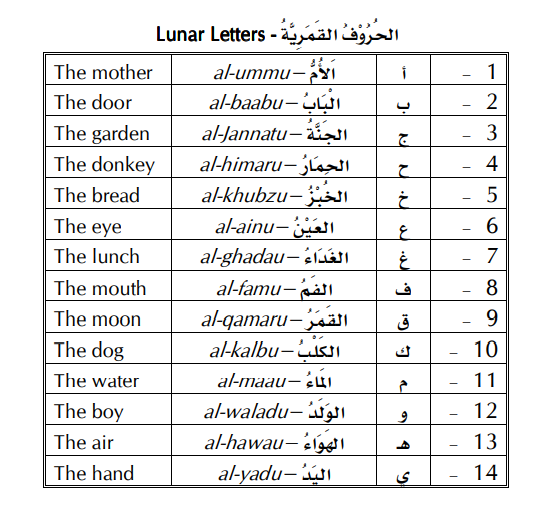
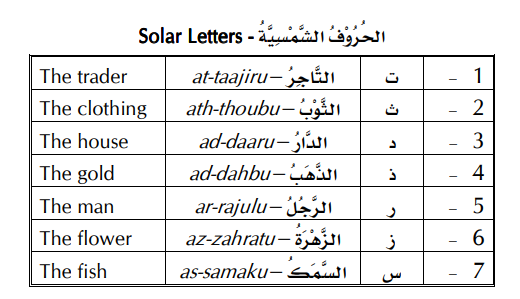
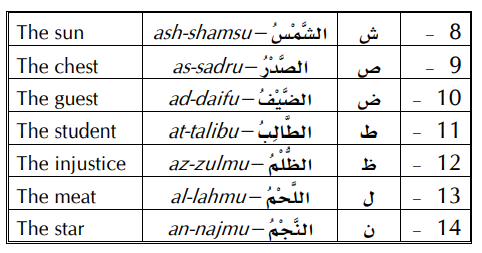
Arabic has 28 alphabets or letters; of these, 14 are called the Sun Letters (الحروف الشمسية) and the other 14 are called the Moon Letters (الحروف القمرية) In the moon letters the lam ( ال) of al is pronounced like (القمر) al-qamaru’). While in the sun letters the lam of al is assimilated to the first letter of the noun like (الشمس) ) ash-shamsu). The
assimilation is indicated by () on the first litter of the noun. A table showing the moon letters and the sun
letters is given below.
سكون – ) Sukun): Signed as ( ـْ) on top of a letter as ‘stop’ or ‘stress’; it indicates that the consonant is vowel less.
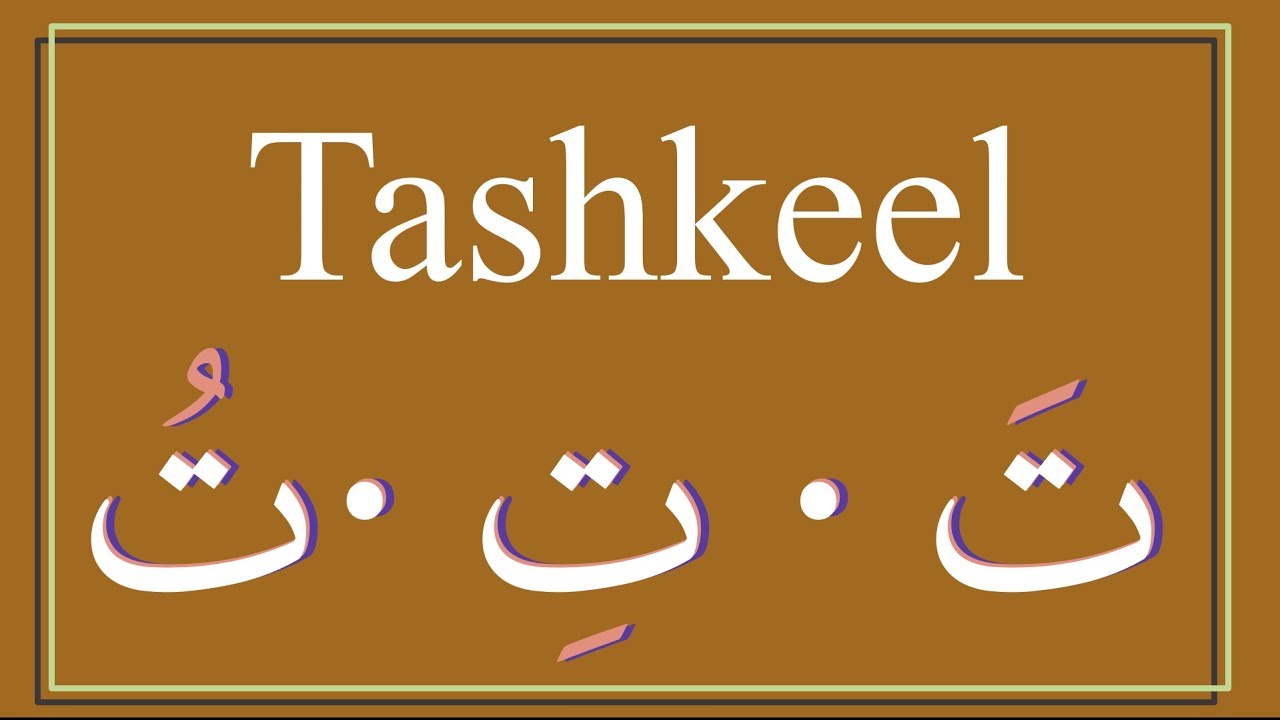
تنوين – ( Double vowels ) ‘N’ sound :Signed as double vowel ( ـًٌ – , ٍ– , )as indicated is called Tanween
Double fatHa: tanwiin with fatHa creates the “an” sound, as in ‘ahlan wa sahlan (ahel-an wah sahel-an; Hi). example : كتاباً (kitaban)
-Double damma: tanwiin with damma creates the “oun” sound. For example, kouratoun (koo-rah-toon; ball) contains a double damma. كتابُ kitabin)
-Double kasra: tanwiin with kasra makes the “een” sound, as in SafHatin (sahf-hah-teen; page) كتابِ ( kitabin).
Remember that a word with Tanwin is always a noun (أســـم) also a word having (al) ( ال ) in the beginning is an indication of its being a noun, however, it does not necessarily.
mean that a word without ‘al’ or Tanwin will not bea noun (أســـم) This is evident from the examples of nouns mentioned above where certain words have neither Tanwin nor ‘al’, yet they are nouns.
It should be noted that the Tanwin and ‘al’ never come together on a noun. If ‘al’ comes in the beginning of a noun then its case-ending will be single vowel, not Tanwin, e.g.. it may be كتب(a book) or ْالكتب (the book). It is incorrect to say : الكتب
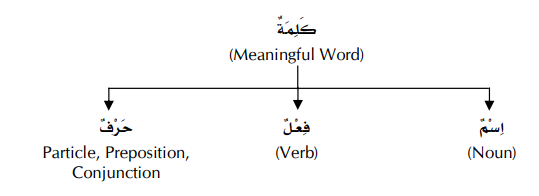
We start the Arabic lessons from the very beginning. A meaningful word in Arabic is called Kalimah (كـــلمــــة). It has only three parts. In other words there are only three parts of speech in Arabic. These are:
Noun ( أٍســــم )
Verb ( فـــعـــل )
Harf (حـــرف)
Noun ( أٍســــم ): literally :name.
Like :‘Muhammad’ (محمد) – Ahmad ( أحمد) – France ( فرنسا) – boy (ولد) – Maryam ( مريم)
It is that word which does not need the help of another word to explain its meaning. It is the name of a person, a place or a thing, and the term Ism includes the adjective nouns ( الصفة) as well.
Verb ( فـــعـــل ):
It is that word by which we understand some work or action being done. It is of three kinds/tenses:
The perfect tense, the Madi (الماضى) is used for an action which is completed,(فعل) he did (كتب) he wrote (دخل) he entered’.
The imperfect tenses the Madari (المضارع) used when an action is not completed ( يفعل) he does or he is doing or he will do ( يكتب) he writes/is writing/ will write( يدخل) he enters/is entering/will enter’.
The imperative tense or the Amr ( الامر) which
signifies command, request or supplication( أفعل)
( أكتب) ‘write ( أدخل) ‘enter’.
The particle, preposition and conjunction are called harf. It is that word which is used with noun or verb to complete the meaning of the sentence; its meaning will depend on the word with which it is used,على ‘on’, فى ‘in’, ان‘regarding’,نعم‘yes’ لا ‘no’ ‘ما that/ what’, etc.
Further explanation and information about the Ism, the Fail and the Harf will follow in the subsequent lessons.
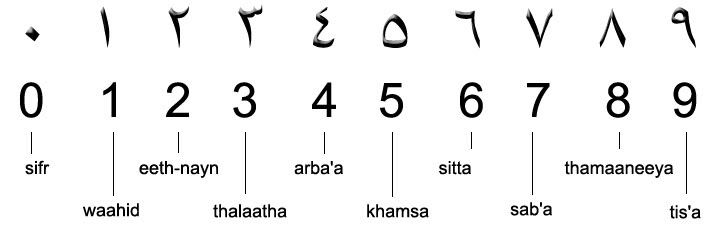
One could be interested to understand that, although you’ll need tolearn a replacement set of Arabic numerals, you really already know a group of Arabic numerals. the foremost wide spread numbering system within the world, the (0, 1, 2, 3, 4, 5, 6, 7, 8, 9) that was adapted by Europe and therefore the Western world within the 12th century AD, is really an Arabic numbering system.
It comes from the Arabic numeral system, which has three families of numerals. the primary family consists of the Hindu numerals, which are utilized in India.
The second family, the West Arabic numerals, were adapted by the western world and are now used for many international commerce.
Lastly, there are the Eastern Arabic Numerals, which are used predominantly within the Arabic speaking world and what you’ll learn below.
Starting from reading is actually way easier. Then, starting from listening, we want to start from the reading and then build our way up all the way to listening. Listening is our goal, really.
I mean, I want to get to the point where I’m listening to the imam, recite the Quran and I can just make total sense of it until the day comes to an end. And I’m engaged with the words of Allah, that’s a final skill that’s like when you’ve reached your goal, kind of in in your study of Arabic. That’s a pretty major milestone. It’s not the highest milestone. What’s a pretty major milestone when you can stand in prayer and understand even one phrase or to phrase, you start picking things up. That’s pretty cool.
We can start getting there soon, but eventually you want to get to the point where anything you recite, maybe one or two words you’re missing, and then you could look those up. Or you can ask the person who led the prayer here. What did you mean by what word is that what stood out was that from? And you can find that out and build that, Okay, in any case. So I’ve started with four skills once again because I want you to remember the stuff we started with the output skills writingand speaking. And we eliminated those for the purpose of Quran study. Then we talked about listeningand readingand be eliminated.
We’re gonna focus.
1-The first one :
You’re going to read the Quran and try to make sense of what you are reading. And that’s cool. That’s actually a pretty easy way to narrow down your focus. Okay, so that’s the first one before most part of the discussion today that I wanted to get out of the way. Don’t worry about what? Stop stressing yourself out about vocabulary. It will come. I promise you it will come and you’ll be very good at it. And actually, the vocabulary of the Quran is easier than most of the vocabulary of Arabic.
You can’t just have the you know which book should I study. Books are just, uh, information. It’s what method will I use to teach that book right? The method has to be right for a student to be able to really retain their stuff, so it’s not just about getting a book and going through it, and you’ll get it.
2-The second thing is:
clear objectives. Now that we’re worried Onley about reading, let’s get clear about our objectives if you are someone and I’m only gonna talk about three groups today, right? And then we’re gonna be done with this session First group.
If you’re somebody who knows absolutely zero about the Arabic language, you know nothing about the alphabet you know nothing about. You know, the pronunciation. You’re absolutely zero. Okay, you know nothing. Or you’re someone who used to know. And now you for gotten okay. Now you don’t remember what it was or you You read it so poorly, you’re almost embarrassed to read it in front of somebody else, right? Or even to yourself out loud. You feel hesitation in doing that then And many of you if that If that’s the beginning level you’re at. It’s gonna be hard for you to go to a mush it and sit down with a bunch of like, 11 year olds and they’re reading better than you are. And you’re saying that embarrassing yourself, it’s gonna be hard, right ?
You could maybe take a college course.
College courses are pretty expensive on. Also, when you go to a college course, they’re not going to say we’re just gonna focus on reading. They’re gonna say, reading, writing, speaking, listening. There you go again. I’m focused on four skills where I needed to focus on one. That’s another problem. You could try to do this on your own on. That’s gonna be a challenge, and sometimes you try to do it with a tutor online. Many of you have tutors online, and for some of you it’s a hit or a miss. Sometimes you make it.
Sometimes you don’t, and sometimes they’re pretty good. Ah, lot of times there because they’re foreigners themselves. They wanna take you on a pace that they’re used to, or that they’re used to teaching kids and kids don’t learn the same way as adults. Kids are sponges. They can pick things up quickly. But you’re 35 years old. You’re 27 years old. You’re not gonna be able to pick up quickly as Children.
And now you start feeling inadequate and you get de motivated. I take you back to the first challenge. If you’re not motivated, you’re not gonna learn.
This session to I’m gonna talk to you about, you know, we’re zoning in on studying the Arabic for the purpose of understanding that we’re on. And just so everybody again has a heads up,I do want you to remember some of these things that I’m sharing with you. This is not relevant. Maybe for everybody but those of you that are interested in learning Arabic to help. You understand the Koran. I think you’ll find this discussion beneficial. Okay, so when it comes to learning any language, you wanna be able to acquire four skills, Okay? There any language that you’re good at you you wanna be able to say I have four skills in that language.
Those skills are:
Reading, writing, listening and speaking. I’ll say that again. Reading, writing, listening and speaking. And the way to organize those skills. Like when you go to like, I used to study Spanish in high school, and, I’m trying to learn some Turkish now, at one point or another. I’ve tried to learn several other different languages.
For example:
The listening When you go to a language class, your professor, your teacher will get you to say something speaking, I’ll get you to say my name is this or here’s how you say hello or here’s how you say Welcome. Here’s how you say Good evening, etcetera, etcetera. Right, that’s speaking.
They’ll try to introduce you to the alphabet of that language that’s writing. Obviously they’ll say something and expect that you understand what they said.
The reading They’ll put words on the board or in your textbook, and they’ll expect you to read it in that language the way it’s supposed to be pronounced. I want you to take those four skills reading, writing, speaking and listening and restructure them.
Reorganize them in your mind again. We’re learning not Spanish or German or French. Actually, we’re not even learning Arabic for a general purpose. We’re learning Arabic to understand the Quran. It’s a very specific purpose. Are entire study of the language is focused primarily first on a book and then everything else in that language.
4 tips on how to learn Arabic successfully
In beginning, The speakingbecomes less important. And writingbecomes less important. Because for the average Muslim who just wants to understand the Quran, they’re not going to sit there and right, so little because they’re gonna read it, they’re not gonna write it. And even if they never learned how to write it properly, it wouldn’t make a difference. They’re not interested in writing.
So writing is not a top priority. If you’re studying Arabic for the purpose of the Quran especially those of you that are trying to study this part time, you have limited time to study anyway. And you want to make the most of every minute of effort you’re gonna put in too. Learn why would you spend time learning and and prioritizing something that won’t take you to your immediate goal ?
So writing is basically you put an X on it. In the beginning, there’s we’re not gonna focus on writing the same thing about speaking. I mean, okay, you know now how to say that it’s the weather is nice today or it’s sunny today.
So what ?
How is that gonna help you understand when the Imam reciting the prayer or when you’re reciting the Koran? So you’re speaking skills are about you producing language. You producing words on you expressing yourself. It’s not about understanding the Koran. So as an early skill set, even though in a normal Arabic classroom, these air or any foreign language classroom, these are like top priority skills, you start with these. Like if you don’t have this, what do you have that kind of thing? You know? And even if your friends say, Hey, Rahman Rahim .
So we come back to that. I mentioned four skills at the top of this session. I’ve reduced it now to to skills. It’s two skills are gone. Writing is gone for now, and speaking has gone for now. So what’s left. What’s left is reading and listening.
What’s left is reading and listening. Now, even within reading and listening will prioritize. By the way, focusing on two skills is way easier than focusing on four skills, isn’t it ?
For example.
if I’m listening to Arabic, I’m trying to process that information that it goes through my ears and my brains, trying to make sense of what’s being said the same way. If I’m reading, my eyes are taking these words and they’re making. I’m trying to make sense of it in my head. That’s input. But when you’re speaking or writing its output, you’re producing stuff.
So for the purposes of understanding the text of the Quran , the sacred text. We’re focused on input. We’re focused primarily on input now within input. One of them is a lot harder than the other. Uh, listening is way harder than reading.