Surah Al-Ikhlas Translation & Tafseer

Surah Al-Ikhlas Translation & Tafseer

1- Al-Ikhlas ( MONOTHEISM ).
2-Arrange of Surah : (111).
3-Number of Ayats: (4).
4-where revealed: Makkiyah.

Learn Surah Al-Ikhlas12
 Say, “He is Allah, the One.          (قُلْ هُوَ اللَّهُ أَحَدٌ ( ١
Allah, the Absolute.       (اللَّهُ الصَّمَدُ ( ٢

He begets not, nor was He begotten. (3)  لَمْ يَلِدْ وَلَمْ يُولَدْ
And there is nothing comparable to Him. (4) وَلَمْ يَكُنْ لَهُ كُفُوًا أَحَدٌ

Quranmyway

The Deep Meaning (Tafseer).

1. Say: “He is Allah, (the) Unique.   قُلْ هُوَ اللَّهُ أَحَدٌ

قُلْ

Say: This chapter describing Allah begins with a command to the Messenger of Allah (r) to convey the contents of the chapter to the pagans who asked him to tell them about his God’s lineage. According to Ibn al-Qayyim, it is also
affirmation of the Prophet’s (r) position of being only a conveyer, a messenger, one only speaking what he was commanded to say.

هُوَ

He The description begins by referring to God using the third person singular pronoun “he” as is found in the Bible and other religious texts. With the rise of feminism in the 20th century, the question of God’s gender became an issue and attempts were made to rewrite the Bible free from “gender-bias”.

Muslims did not fall into this trap because the Arabic Quranic text could not be changed.

اللَّهُ

Allah Allah” is the name of the Lord, the Exalted. It is said that it is the Greatest Name of Allaah, because it is referred to when describing Allah by His various Attributes. For example:

هُوَ اللَّهُ الَّذي لا إِلهَ إِلّا هُوَ عالِمُ الغَيبِ وَالشَّهادَةِ هُوَ الرَّحمنُ الرَّحيمُ

He is Allah, besides whom none has the right to be worshipped, the All Knower of the unseen and the seen. He is the Most Gracious, the Most Merciful.

Learn Surah Al Ikhlas with Tajweed Rules

أَحَدٌ

The Uniquely One. As a title, al-Ahad is only applicable to Allaah and it signifies, He who has always been one and alone; or the indivisible; or He who has no other to share in His Lordship, nor in His Essence, nor in His Attributes.30 Though both the terms ahad and waahid mean basically “one”, there is a subtle difference between the two in usage and meaning. For example, one would not say: rajulun ahadun (meaning: one man).

Learn Surah Al-Ikhlas with Arabic teachers

2. “Allaah, the Self-Sufficient.   اللَّهُ الصَّمَدُ

In this verse Allaah elaborates on His Uniqueness (ahadiyyah) mentioned in the first verse. Here, He uses the term samad which means that He is perfect in all of  His Attributes and that all creation is in need of Him.
Ibn ‘Abbaas was reported to have said that as-samad meant, “He is the Master [as-Sayyid] who is perfect in His sovereignty, the Most Noble [ash-Shareef] who is perfect in His nobility,

وَمَا خَلَقْتُ الْجِنَّ وَالْإِنسَ إِلَّا لِيَعْبُدُونِ

The purpose of our creation is to worship Allah. That is crystal clear in the revelation. Our purpose was not left to be deduced or discovered, but was stated in no uncertain terms in the books of revelation. However, it is only in the Quran, the final revelation, that that purpose is spelled out and thereby remained clear over the generations since its revelation.

Online Quran Teaching By Chat GPT

3. “He does not give birth, nor was He born.  لَمْ يَلِدْ وَلَمْ يُولَدْ

This verse is a continuation of the presentation of detailed examples of Allah’s Unique Oneness. False religions generally represent God in human terms by either giving Him human characteristics and or human form.

This verse deals primarily with two distinct characteristics of human beings and other living creatures in general: coming into existence by being born and procreating by giving birth.

Surah Fatiha Names

لَمْ يَلِدْ

He does not give birth,” because there is nothing similar to him. A child is made from portions (sperm and ovum) of the bodies of its parents which is why it is similar to its parents in form and characteristics.
If God gave birth, there would be another god besides Him, which He has already negated.

أَنَّىٰ يَكُونُ لَهُ وَلَدٌ وَلَمْ تَكُن لَّهُ صَاحِبَةٌ

وَمَا يَنبَغِي لِلرَّحْمَٰنِ أَن يَتَّخِذَ وَلَدًا

But it is not suitable for the Most Gracious that He should have a son.” (Sorah Maryam, 19: 92)

وَلَمْ يُولَدْ

Nor was He born. Although relatively few people believe or have believed that God was born, the question of God’s origin is often raised by skeptics and atheists. Anas ibn Maalik related that Allaah’s Messenger (r) said: “Indeed, your people will continuously question about this and that they will say:

4. “And there is none equal to Him. وَلَمْ يَكُنْ لَهُ كُفُوًا أَحَدٌ

Allah closes the chapter with a restatement of the opening verse. If God is unique, nothing can be equal to Him. If nothing is equal to Him, then He alone is unique.

If He alone is Self-Sufficient and all creation is in need of Him, nothing in creation can be equal to Him.

If He does not bear offspring, nor did anyone or anything give birth to Him, nothing or no one can be equal to Him as every created thing came into existence after a period of non-existence.

The Reason for the Revelation of Surah al-Ikhlas:

There is one authentic narration indicating the circumstances under which this chapter was revealed. The Prophet’s (r) follower, Ubayy ibn Ka‘b, related that some of the pagans asked Allaah’s Messenger (r) to list the lineage of his
Lord so Allah revealed: “Say: He Allah is Unique, Allah is Self-Sufficient.

Thus, the chapter was revealed specifically to clarify the uniqueness of Allah for idol worshippers in the Prophet’s (r) time who believed that their gods had fathers, mothers, sons and daughters.

Place of Revelation:

There are no authentic hadeeths which clearly indicate where this chapter was revealed. However, most scholars of Tafser (Quranic exegesis) hold that it was among the early chapters revealed in Makkah [prior to the Hijrah] as it has most of the characteristics of the Makkan revelations.
Surah Al-Falaq Translation & Tafseer

Surah Al-Falaq Translation & Tafseer

Surah Al-Falaq Translation & Tafseer:

1 al-Falaq ( DAYBREAK ).
2-Arrange of Surah : (113).
3-Number of Ayats: (5).
4-where revealed: Makkiyah.

Surah Al-Falaq Translation
Say, “I take refuge with the Lord of Daybreak.         (قُلْ أَعُوذُ بِرَبِّ الْفَلَقِ ( ١
From the evil of what He created.       (مِنْ شَرِّ مَا خَلَقَ ( ٢
And from the evil of the darkness as it gathers (3) وَمِنْ شَرِّ غَاسِقٍ إِذَا وَقَبَ
And from the evil of those who practice sorcery. (4)  وَمِنْ شَرِّ النَّفَّاثَاتِ فِي الْعُقَدِ
And from the evil of an envious when he envies (5) وَمِنْ شَرِّ حَاسِدٍ إِذَا حَسَدَ

The Deep Meaning (Tafseer).

1. Say: “I seek refuge with the Lord of the Dawn,

قُلْ

“Say:.” This command to the Messenger of Allaah (r) affirms to the reader or listener that the Prophet (r) was only a messenger conveying what he was commanded to say. He had no control over the revelation with regard to its content or to its time or place of revelation.

It reinforces the Muslim belief that the Quraan is the word of God and not that of Muhammad (r). During the Prophet’s time, the pagans, believing at first that it was the Prophet’s magic, requested him to modify the message to include elements of their idolatry so it would not affect their economy.

أَعُوذُ

“I seek refuge…” by fleeing from something I fear to what I believe will protect me from it. This expression carries the strength of an oath. Which is why the Prophet (r) divorced one of his wives who used it against him, even though she
did so in ignorance.

When the daughter of al-Jawn was sent to the Prophet (r) on their wedding night and he put his hand on her, she said, “I seek refuge in Allaah from you,” as she had been deceptively advised by some of the Prophet’s wives. The Prophet (r) told her, “You have sought refuge with the ultimate Savior. Go back to your family.

Surah-Al-Falaq

Consequently, Allaah required it on many occasions beginning with the recitation of the Quraan itself saying:

 فَإِذَا قَرَأْتَ الْقُرْآنَ فَاسْتَعِذْ بِاللَّهِ مِنَ الشَّيْطَانِ الرَّجِيمِ

So when you want to recite the Qur’aan, seek refuge with Allaah from Satan, the cursed one.” (Soorah an-Nahl, 16: 98)
learn quran free

Start Free Trial

بِرَبِّ الْفَلَقِ

with the Lord of the Dawn,” Allaah. Though the word falaq has been translated here as the dawn, it also refers to everything which Allaah splits like the date stone and the seed.33 This title, Splitter of the Seeds, alludes to His
attribute of Life giver.

2. “From the evil of created things.   مِنْ شَرِّ مَا خَلَقَ

means from the evil of all created things including first and foremost one’s own soul, for it is the human soul that usually prods the body to commit evil, as Allaah quoted Prophet Yoosuf (peace be on him) as saying:

وَمَا أُبَرِّئُ نَفْسِي ۚ إِنَّ النَّفْسَ لَأَمَّارَةٌ بِالسُّوءِ إِلَّا مَا رَحِمَ رَبِّي

“And I do not declare myself innocent. Indeed, the soul is inclined to evil, except when my Lord bestows His Mercy.” (Soorah Yoosuf, 12: 53)

“From the evil …”
According to Ibn al-Qayyim, there are basically two types of evil which can befall a person:
1. Either sins committed for which he is being punished. In this case, the occurrence of evil is due to the person’s own actions, intentions and efforts. This type of evil is the “Sins and their Consequences”, which is the greater of the two types of evil, the more prolonged and more severe on the sinner.
2. Or evil befalling the person from others who are either responsible or not responsible. The responsible being is either similar to the person as in the case of another human being, or dissimilar as in the case of the jinn. The non-responsible sources include pests which bite and sting, and so on.

3. “And from the evil of nightfall.   وَمِنْ شَرِّ غَاسِقٍ إِذَا وَقَبَ

The Almighty warns the believers about the night even though the night is among His mighty signs confirming His existence in the minds of those who reflect.

Refuge is sought from nightfall because the night is a time in which the forces of evil become most active. Under the cover of darkness, the evil elements are able to operate most freely. Most crimes are committed during the night and places of corruption like bars, discos, strip-clubs, and so on, do most of their business during the night. The night provides a cover in which the evil forces can operate without being easily identified and avoided.

Based on this, Ibn al-Qayyim pointed out that the secret behind seeking refuge with the Lord of the Dawn becomes clear; for the dawn represents the beginning of the day and the appearance of light which repels the armies of darkness and the evil elements of the night. The filthy and corrupt people.

Surah-Al-Falaq

4. “From the evil of those who blow on knots   وَمِنْ شَرِّ النَّفَّاثَاتِ فِي الْعُقَدِ

Allaah mentions in this verse the second major source of evil in His creation, the evil of sorcerers and witches. Thus, this verse focuses on magic and those who practice it.

refers to witches and warlocks who tie knots in threads while blowing on each knot in order to cast spells. This was a common method used in many parts of the world.

MAGIC:

Magic may be defined as the seeming control or foresight of natural forces or events by ritual invocation of supernatural beings. It includes the belief that men can coerce nature by the use of certain rites, formulas and actions.

In Arabic the term sihr (magic) is defined as whatever is caused by hidden or subtle forces.
For example, the Prophet (r) was reported to have said, “Verily, some forms of speech are magic [sihr].”
The speeches of an eloquent, charismatic speaker who makes right seem wrong and vice versa, fall into this category. Thus, the Prophet (r) referred to some aspects of speech as being magical.

According to Islamic law, magic defined as “a contract or incantation, spoken or written, or something done which will affect the body, heart or mind of the one bewitched without actually coming in contact with him.”


5. “And from the evil of the envious when he envies.   وَمِنْ شَرِّ حَاسِدٍ إِذَا حَسَدَ

The Almighty mentions the third of the major areas of evil from which refuge should be sought.

The Evil Eye:

A part of Islaamic belief is the concept of a type of glance capable of causing harm to those upon whom it befalls.
Ibn ‘Abbaas reported that the Prophet (r) said: “The effect of the evil eye [al-‘ayn] is real, for if there were anything which could overtake destiny, it would have been [the effect of] the evil eye.

The evil eye is a form of jealousy (hasad). Ibn al-Qayyim said, “Every possessor of the evil eye is jealous, but not every jealous person possesses the evil eye. Since the category of jealousy is general and the evil eye specific, seeking refuge from jealousy includes seeking refuge from the evil eye.

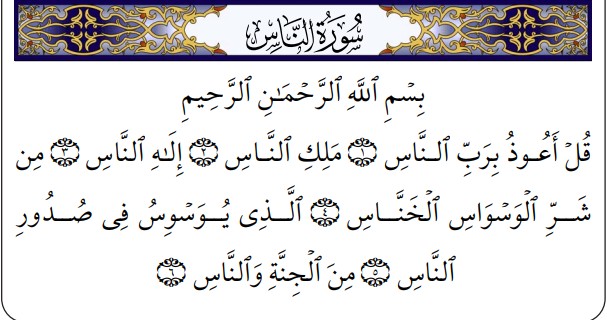
Surah Nas Translation & Tafseer

Surah Al-Nas Translation

1-An-Nas ( MANKIND ).
2-Arrange of Surah : (114).
3-Number of Ayats: (6).
4-where revealed: Makkiyah.

Learn Surat An-Nas (114)

Say, “I seek refuge in the Lord of mankind.          (قُلْ أَعُوذُ بِرَبِّ النَّاسِ (١
The King of mankind.        (مَلِكِ النَّاسِ (٢

The God of mankind. (3) إِلَهِ النَّاسِ
From the evil of the sneaky whisperer. (4) مِنْ شَرِّ الْوَسْوَاسِ الْخَنَّاسِ
Who whispers into the hearts of people. (5)  الَّذِي يُوَسْوِسُ فِي صُدُورِ النَّاسِ
From among jinn and among people. (مِنَ الْجِنَّةِ وَالنَّاسِ ﴿ 6

  ⇒ We Have Course For Explain  Surah Nas See New offer ⇐

Deep Meaning (Tafseer).

1. Say: “I seek refuge with the Lord of humankind,

قُلْ أَعُوذُ

“Say: ‘I seek refuge ” Allaah’s command to the Messenger of Allaah (r) affirms to the reader or listener that Prophet Muhammad (r) was only a messenger conveying a divine message and not the author of the Quraan.

It is among the clear evidences which prove that the Qur’aan is the Word of God and not a product of Muhammad’s (r) literary skills. The Almighty clearly states that in the Qur’aan:

وَمَا عَلَّمْنَاهُ الشِّعْرَ وَمَا يَنبَغِي لَهُ ۚ 

And I have not taught him poetry, nor is it suitable for him.” (Soorah Yaaseen, 36: 69)

بِرَبِّ النَّاسِ

With the Lord of humankind.” Mention of His Lordship (ruboobiyyah) over humankind includes the fact that He created them, designed them, and He manages their affairs. He is responsible for their upbringing and their education.
It is He who rectifies and improves their situations and it is He alone who protects them from harm and guards them from corrupting influences.

All of that can only take place if He has absolute power, shows supreme mercy and desires only goodness for His creatures. Furthermore, He must possess intimate knowledge of the finest details of their various situations, while being able to answer all their prayers and requests, and remove all their calamities and distress.

The Almighty mentioned that He is the Lord of humankind, though He is the Lord of all creation, for two reasons:

    1. Because humankind as a whole has been exalted and honored above most of creation. Thus, by mentioning them in particular, He informs humans that He remains their Lord and Master regardless of how great they may become.
    2. Because He instructed that refuge be sought from their evil. Thus, by mentioning them specifically, He clarifies that only He can provide refuge for them.

Start My Free Trial

2. “The King of humankind.”    مَلِكِ النَّاسِ

Allaah’s “Kingship” implies that He alone has absolute power and authority over humans and they are all His slaves and possessions. He is the King of kings, which is why the Prophet (r) prohibited anyone from taking this title.1 Allaah is the true King who alone can provide security for people in times of calamity and difficulties. He is the Only One who can come to their aid if they come under attack from their enemies.

3. “The God of humankind.”    إِلَهِ النَّاسِ

Allaah further describes Himself as the true God of human beings and thereby negates the existence of any other legitimate objects of worship in creation. Just as He alone is Lord and King and no one shares in His Lordship or His
Kingdom, He alone is their God and the Only One deserving their worship.
Thus, it is inappropriate to associate partners in His Divinity just as He is without associates in His Lordship and Dominion.
This is a common method used throughout the Qur’aan. After affirming their Tawheed (Unitarianism/monotheism) in regards to Allaah’s Lordship and Dominion, Allaah calls on them to recognize the Unity of His Divinity which
they were denying.
If He is Unique in His Lordship, Dominion and Divinity, it is obviously incorrect to call on, fear, have hope in or love anyone or anything besides Him.
No one should be submitted to, called upon or trusted in besides Him. For, whoever one submits to, calls upon or trusts in is either the real sustainer and maintainer of human affairs who is none other than Allaah, or he is a slave of
Allaah.

4. “From the evil of the whisperer who withdraws. مِنْ شَرِّ الْوَسْوَاسِ الْخَنَّاسِ

Allaah follows the same presentational pattern of the previous chapter to which this chapter has been twinned. After describing with whom refuge should be sought, the Almighty identifies from which aspect of creation refuge should be sought, it is the last major area of evil in this world, the Devil.

مِنْ شَرِّ الْوَسْوَاسِ

From the evil of the whisperer.” What is meant by “the whisperer” here is one who inserts or introduces false thoughts, imaginations, views, and opinions into the heart. The form of the Arabic word for whisperer “waswaas” is an intensive form indicating continual whispering and not just an occasional whisper.

الْخَنَّاسِ

“Who withdraws,” and runs away when the name of Almighty Allaah is mentioned. That is Satan who, as the Prophet (r) said, runs away when the call for prayer is made. Both calls to prayer have the ability to drive away the devils.

5.“Who whispers in the souls of humankind.   الَّذِي يُوَسْوِسُ فِي صُدُورِ النَّاسِ

The third characteristic of Satan is mentioned in this verse. The first characteristic is that he is an incessant whisperer, constantly suggesting evil.

The second is that he appears and disappears, deceiving his clients or targets into thinking that he has left them only to appear once again when they least expect him, when their guards are down. The third is depth to which his  hisperings can reach.

And:

The Almighty gave Iblees and the evil jinn the ability to enter human beings and affect their hearts and minds.
Safiyyah bint Huyayy, wife of the Prophet (r), reported that she went to Allaah’s Messenger (r) while he was in seclusion (i‘tikaaf) in the last ten days of Ramadaan. She had a talk with him for a while, then she got up in order to
return home. The Prophet (r) accompanied her and when they reached the gate of the mosque, opposite the door of Umm Salamah, two men from the Ansaar greeted him as they passed by. He called them back saying, “Don’t run away.
She is my wife, Safiyyah bint Huyayy.” They replied, “Glory be to Allaah, O Messenger of Allaah, [we could never have thought otherwise]!” They felt embarrassed. But the Prophet said to both of them.

(إن الشيطان يجري من ابن آدم مجرى الدم ، وإني خشيت أن يقذف في قلوبكما شيئا )

“Verily, Satan flows in the bloodstream of Aadam’s descendants.

6. “Among the jinn and humans.   مِنَ الْجِنَّةِ وَالنَّاسِ

could refer to the two groups of people in
whose hearts the whispers enter. In which case, the verses would mean, “He
whispers in hearts of people from among the jinns and humans.”
This was the opinion of al-Farraa and his students, however it is weak because there is no evidence that jinns whisper into the hearts of other jinns, or possess them as they do humans, flowing through them like blood flows in the veins.